
Tags
computer virus, depression, ghost in the machine, horror, pulse, remake, review, suicide, technology
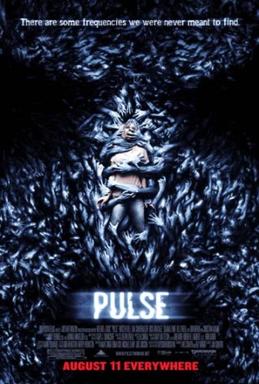
After the undeniable success of The Ring remake in American theaters, studios couldn’t get enough of Japanese and Korean horror remakes, and in usual movie-studio style trying to take advantage of a good thing until it isn’t good anymore, they wrung that trend for every dollar they could (and continue to the day, with the enraging announcement that the incomparable Korean zombie movie Train to Busan is getting an entirely unnecessary American remake). Also as usual, only the first few entries really had anything to offer. The Grudge was a decent follow-up to The Ring, even if it lacked its own identity. I would put Pulse up there as an entry that really had no right to work the way it did, because on the surface, it feels generic, like something an autobot would create, which may or may not be ironic.
Keep in mind during this review that I haven’t seen Kairo, the original Japanese move that inspired Pulse. It’s on my list of things to watch, but I simply haven’t had the opportunity. So I can’t compare the quality. I can only judge Pulse on its own merits. Also, I’ve only seen the unrated version, so I can’t speak to what elements were in the theatrical release versus what was in the unrated release.
Was Pulse great? No. Was Pulse good? Sometimes, but I wouldn’t call it particularly original. Was Pulse good enough? That’s where I would put it. Moments of interest suggest there was something more that could have been done with this movie, but I don’t think anyone was really trying for interesting. Wouldn’t be the first time I felt like studios took horror audiences for granted. However, it’s worth noting that, like Gothika, Pulse is semi-regular viewing for me.
It’s also worth noting that, unlike Gothika, the suicide trigger warning is high for this movie. Maybe that’s why I connected to it–as a nearly lifelong sufferer of depression, the suicidal impulse isn’t as far away from me as I would like, so the movie ends up reflecting something I find in myself all too often. As a consequence, though, I have to be careful about when I watch it. I don’t let myself watch it when I’m in a deeper depression and suicidal ideation is high. I think trigger warnings on horror can be a bit redundant—I’m not entirely sure what else people expect from a horror movie—but I have a strong enough reaction to Pulse if I watch it at a bad time that I feel compelled to provide the warning. The warning means that the movie works for what it intended to convey, so it’s not a bad thing. Just a preliminary flag, in case you might have the same issue.
Like I said before, Pulse really shouldn’t work as well as it does. For one thing, it presents us with highly CGI monsters–even the fact that they’re from a digital reality doesn’t really fix the way that heavy CGI doesn’t register as real enough for horror work. It’s a big no-no for me and often undercuts the work of legitimate body actors. I’ve lost count of the time that Doug Jones and Javier Botet suffer from the over-digitization of their characters. And frankly, I can’t think of a single digital effect that has scared me.
Even when they minimize the digitization effect, however, the monsters just don’t…do it for me. They’re not frightening, and the sucking the life effect isn’t scary. The closest to effect that we get is Stone’s demise, with his distinctive face distorted as he dissolves into the wall, the bulging of his eyes. The black mold bruising effect is pretty, but I’m not sure it signifies disease quite the way it could have. I guess it just felt a bit mild and underdone, visuals we’ve seen before that don’t stand out in a crowd of monsters. Generic ghosts in the machine. Just…meh. Not the reaction you want from a horror movie.
A lot of the horror movies of the new millennium aughts tended to be heavily filtered with a prevailing color that bleeds into every element of the movie. For Pulse, they chose a Matrix-y green to contrast with the bright red computer tape for a Freddy Krueger combination that was only occasionally effective. I suspect the scenes where the contrast was strongest were taken almost straight from shots in the original, but I can’t speak to that, because I haven’t seen the J-horror version. There was just something about the angle and framing of those shots that reminded me of Japanese horror that I have seen.
Unfortunately, the times it didn’t work were when the scenes were too flooded with the filter of choice, whether red or green. The Ring depended a lot on blue and blue-green filters, but that really fit rainy Seattle and the thematic water element of the movie, especially since it had its moments of color—the green of Shelter Mountain Inn and the light hitting the Japanese maple. A filter works best when it enhances the atmosphere, and I’d say that it worked really well in Josh’s apartment, where we’re given a good sense of the emotional deterioration that has led to real physical decay. But at many points in the movie, the filter becomes more saturated to distraction rather than effect.
The cast manages to take the movie seriously, even if I’m not sure the director does. We have Brad Dourif and Octavia Spencer in notable cameos, and Pulse introduced me to Rick Gonzalez, who’s one of those people who just makes me happy when I see him guest-starring now.
Ian Somerhalder as Dexter is a bit uneven, and I don’t get a good sense of why he’s there, other than Generic Love Interest and looking pretty, but you know, I’m easy and I’ll take it. He’s riding his Lost high but hasn’t entered Vampire Diaries popularity yet, so it’s a nice look at him before that.
Jonathan Tucker pads his horror cred with a memorable turn as Josh, flexing his exceptional skill at setting a mood with his own subtle body work and his quiet intensity.
The real surprise here for me is Kristen Bell as Mattie. At the time of the movie, she’s riding her own TV high from Veronica Mars and had yet to find Forgetting Sarah Marshall, Frozen, or The Good Place fame. With her fair coloring, she’s the least served by the sick green filter, because she ends up seeming like she’s spent too much time in a chlorinated pool. In addition, the makeup artist went rather Avril Lavigne with the smoky eye, but I kind of like it.
Bell usually brings this sort of cheerful snark into her work that she uses really well, but it’s not something that she can really take with her into a horror movie. And she doesn’t. Like Julia Roberts in Mary Reilly, Kristen Bell doesn’t bring any of her trademark sunny hardness to the role, barely even smiles. It’s a story about a suicide epidemic, so there’s precious little to smile about. But as a small, slight woman, Bell uses the vulnerability and persistence in her tool belt instead. It speaks to her skills that she manages to make for an unexpected horror lead. She’s not a Scream Queen, but she holds her own with her grief for the death of her boyfriend and her commitment to fighting what seems inevitable while everything falls apart around her.
The cyber element of the movie seems quite dated at this point, as most technology-based horror does. The Ring played up the obsolescence of videotape, but Pulse presents itself as tech-savvy, which means the tech ages badly, and of course the Hacker Magic element that triggered the release of the computer virus monsters is laughable, even to this profoundly tech-unsavvy viewer, so it’s a good thing they don’t dwell much on the why—because the why doesn’t really matter as much as as the ‘what now?’
What works in Pulse, as is true for most horror movies, is where the horror gets unmistakably human—in Josh’s despair when we first see him post-computer-virus-monster attack; in Mattie’s psych student grief, especially when she visits Josh’s apartment before he dies and after; in Stone’s memorable demise; in Isabelle’s monologue that basically covers how depression feels at its worst; in the way that each infected person speaks as though something’s weighing on the tongue, walks and stands as though carrying a burden on their shoulders, sometimes has trouble just convincing themselves to talk or pick up a phone. It’s a very real representation of depression, and I’m there for it.
Pulse reuses the unsettling video gimmick that implanted The Ring‘s Samara into the horror collective and has been reused many times since without much success (I’m looking at you, Slender Man and Friend Request). However, the virus here shows streams of people’s deepening despair, sometimes the moment of their suicide, with the added Internet uncertainty of whether they’re real or just a sick prank, and it feels more real than any of the other Ring imitators. At the moment that the computer downloads the virus, the images infect the viewer with the same sense of despair.
Scarily enough, suicide is, in fact, contagious, especially when it’s shared in the wrong way or when we dwell in the suicidal moment itself, which is why I do post the trigger warning, because that’s the exact moment that the virus shares, over and over and over again.
Also, although the script is terrible, especially for the light-hearted bits, and written by people who had never heard a college student in the early aughts talk, the quiet moments actually bring up some interesting thoughts about technology and communication.
Sure, the big Ghost in the Machine horror element is that we’re surrounded by technology and have integrated it into our lives so much that something destructive within it would destroy us in a matter of days. That’s pretty much a given and the reason real AI can be a terrifying prospect. It also makes some hackneyed comments on how the Young People These Days are lost in their tech—the same argument being made in Ghost in the Machine horror today, with the same eye-roll from the audience. The truth is, the problem isn’t what technology we use. The problem is in how we communicate and relate with one another—or the ways we don’t communicate or relate. It’s not the tech that’s gotten in the way of our communicating with each other. Tech is just the tool, and like any tool, it’s fairly neutral—what matters is how it’s used. If you think the loners who spend all their time online would be social butterflies if WoW had never been invented and that influencers would be less addicted to what people think of them, maybe you’ve forgotten what it was really like to be in a world without Internet.
In the movie, we see how technology helps forge emotional connections—a phone call between friends, chatrooms to deal with grief. And we see how tech is used in miscommunication or lack of communication, with Mattie ghosting Josh, Josh not calling Mattie back, the phone call between Mattie and Stone when Stone isn’t saying what he’s feeling…for all of these things, the communication issue is because of the people, not the tech. Perhaps the biggest example is in Mattie’s mother trying to call her and Mattie rejecting the call, then Mattie having trouble getting in touch with her mother when she finally needs the emotional connection—with technology allowing Mattie to keep her mother at a distance and the tragedy of missed connection.
The biggest weakness in Pulse, other than the fact that the remake conceit is already tired in 2006, is the ending. Horror endings are notorious for falling short of the build-up. Screenings show that at least part of the reaction to an ending is cultural (see the American v. the British ending of The Descent), but it’s also very much a pitfall of the horror genre in general. It’s such a delicate business, giving horror a satisfying ending, and it doesn’t happen very often, even among the greats.
But the writers (one of whom was Wes Craven, but everyone agrees they just wanted his name on the film to bolster it) wrote themselves into a corner and hit their nose squarely in that corner when they tried to wrap everything up at the climactic scene. And then we’re given an epilogue that feels tacked on as an afterthought—perhaps in response to unfavorable reactions to the original ending in screenings. And it includes a voice-over explanation. Ew.
I don’t think all voice narrations are a bad thing. It can mimic the effect of first-person storytelling when used correctly (on Veronica Mars, for instance). But when it’s used as a prologue or epilogue or throughout the movie or show in order to explain things along the way, congratulations, you just broke the show-don’t-tell rule by Telling Everything. And all it does is scream in neon letters that the studio doesn’t trust the audience to understand what’s going on, so instead of making it clearer, they just Tell Them.
The voice-over epilogue was completely unnecessary. I think the epilogue still would have felt tacked on without it, but it might have been more effective just by removing the voice-over.
Pulse is not good. But Pulse should have been bad. It doesn’t know whether it’s a throwaway young-person horror movie or an interesting, apocalyptic, depression-contagion horror movie that I feel they should have gone with instead. When you strip away the generic horror elements and some bad dialogue, though, it’s surprisingly decent. Just gauge whether your depression meter can handle a suicide epidemic before you nuke the popcorn for this one.
 (Not to be confused with The Woods. Different horror movie entirely.)
 Amanda M. Blake