 [Warning: Here there be spoilers]
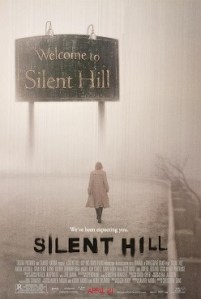
I agonized over what movie I would review for Halloween. I wanted it to be one of my favorites, one I really liked. The Descent? A 1408/Oculus double feature (because yes, they go together)? American Mary? Candyman? I ultimately decided on Silent Hill, one of the first movies I saw during my freshman year of college, when I started watching R-rated horror and really got on the horror train. (Yes, I waited until I was seventeen. Yes, I am that person.)
In the interest of full disclosure, I’m prone to really like my early introductions to things, because that’s before I get jaded. But despite the fact it’s not a perfect film, Silent Hill was surprisingly good, especially for a video game to movie adaptation. Although from what I hear, if you’re going to do a VG2M horror adaptation, Silent Hill is the one to go to. I’ve never played the games myself. I’m too prone to habitual behavior for me to trust myself around video games. So I don’t have any expectations of someone who’s played the game, but the movie pushes so many of my personal buttons. It wasn’t a critical darling, and I can tell why. It’s monster-dense, melodramatic, and as stories go, not very original. But for me it’s less about originality (although that’s nice, too) and more about execution. It may be derivative, but is it a good story? Am I entertained for the night? Am I satisfied? Can I watch it over and over and over again and never get tired of it? Silent Hill is one of those films for me.
This is as much a contemplative retrospective as it is a review. Okay, it’s just me rewatching the movie and geeking out. Bear with me.
One of the most wonderful things about this movie is that the cast was originally so woman-heavy, they had to give Sean Bean a somewhat extraneous side plot just to make men feel included. And it’s one of those rare Sean Bean roles in which he doesn’t die, so… But the movie is a powerhouse of female roles with actresses known for genre films. There is absolutely nothing wrong with this.
Despite being a generally misogynistic genre, horror also historically has these huge, powerful roles for women, especially with the Final Girl trope. But Silent Hill and The Descent, both movies with a majority female cast, are both in my top ten list of favorite movies, with layered, nuanced characters and all different kinds of strength. What’s more, while many of these women are sexy and beautiful, because Hollywood, the movies and their strength don’t derive from those qualities. Or rather, to me, the sexiness comes from the fact their strength isn’t from sex but from character and determination, if that makes sense.
We begin with Radha Mitchell, who is a wonderful, solid leading lady. One of the things you might keep an eye on in subsequent viewings is how her main outfit changes over the course of the movie. It’s supposed to be the same outfit, but the colors subtly change from scene to scene to fit the hue and mood and transitions during the movie. Props to the costume department for coming up with so many forms of the same outfit and making it feel seamless. (Another trivia side note, this is supposed to take place in West Virginia, but it was shot in Canada, which means a certain percentage of the cast needs to be local, so there are all these Canadian accents here and there. It’s a little hilarious, especially when the script has more regional dialogue.)
Mitchell’s character, Rose, and Bean’s character, Christopher, are searching for their daughter Sharon, who’s sleepwalked far from home, screaming “Silent Hill!” when they try to wake her up. This prompts Rose’s research into her adoptive daughter’s origin in the ghost town Silent Hill–a former coal town rendered uninhabitable by a fire–and her plan to secretly take Sharon to Silent Hill to see why she has these terrible night terrors and somnambulism episodes.
Seems like a wonderful plan.
Sharon is played by at-the-time child actress Jodelle Ferland, who’d already dipped her toes into horror by the time she did something as mainstream and big budget as Silent Hill. She was around ten or eleven during filming, and she was still a small girl, but some of her lines suggest that she was supposed to be playing younger, and it doesn’t always land well, maybe because she’s using a little girl voice in her higher register to contrast with the lower Alessa voice. She’s a convincing kid, but there’s a maturity to her that doesn’t really fit the age I felt she was playing. It works when she’s Alessa but not always as Sharon. Still, there’s a reason this girl keeps playing the devil. She’s very good at old-young, which is part of the reason she’s one of the inspirations behind my Snow White character, though she’d now be too old for the role. Nevertheless, her work in Silent Hill has led to me watching her career, and I’m rooting for her as she transitions into adult roles.
But I’m getting ahead of myself. One semi-abduction, police car chase, and car crash later, Rose wakes up on the edge of Silent Hill, surrounded by dense fog and ash floating from the sky like snow. Since I’m not familiar with the games, a lot of these atmospheric elements are new to me, and extremely effective. It’s a beautiful, muted visual. I’m a sucker for pretty horror, and Silent Hill has a lot of pretty and ugly-pretty horror for my needy little eyes. Among all the ash, Sharon is nowhere to be found, thus beginning the scavenger hunt portion of the movie.
I’m being flippant, but it’s actually a good conflict–mother seeking daughter and willing to do anything to find her and keep her safe–and that conflict plus a lot of what follows pays plenty of homage to the video games without feeling too much like one. Finding what’s lost is a classic video game device, and it works just as well in more linear storytelling. It’s basically an ‘into the woods’ quest, with all kinds of monsters and allies along the way.
Once in Silent Hill, Rose quickly discovers that this town is not normal. In Ash Mode, it’s just haunting, unsettling. But Rose follows what she thinks is Sharon into a warehouse. That’s when the emergency siren goes off, and the Ash world flakes away to reveal a hellish interior. It’s a pretty, darn good effect, and I’m not usually a fan of CGI. In Hell Mode (or Rust Mode), that’s when the monsters really come out to play. In the warehouse, it’s the Gray Children, which look like misshapen burning babies. Here’s where the CGI loses it a bit for me. People should be people whenever possible, because anything less than the best motion capture doesn’t move like living things actually move. In the special features of the DVD, I watched the green screen where a small female contortionist donned her Gray Child costume and moved around in it, and that’s honestly creepier for me. Upon another viewing, I think it’s because the proportion of the Gray Children to Rose keeps changing, which jars me out of the suspension of disbelief. However, the Gray Child was my least favorite CGI monster in the movie. All the others are better.
(When the Gray Children scene ends with everything flaking back into Ash Mode, Johnny Cash’s “Ring of Fire” plays on a jukebox in the bowling alley. Everyone in the original theater laughed; good release of tension, and the only funny bit in the movie.)
After the more neutral Ash Mode (I’m sure there’s an actual name for these modes in the video game, but I don’t want to look them up at the moment) returns, Rose runs into Dahlia, a Miss Havisham-meets-Cassandra type character in the movies, although I understand she’s more of an antagonist in the games. Here, she’s the sorrowful mother, a broken woman heavy with cobwebs, dust, and regret, played by the gently altoed Deborah Kara Unger. She chews the scenery in a wonderfully maudlin way and gives us the first bit of exposition about Alessa, the child that was taken from her. When Rose shows her a locket with Sharon’s picture, Dahlia becomes agitated and insists it’s Alessa, her own child.
As Rose continues to look for Sharon and for a way out of Silent Hill, which seems completely cut off from the rest of the world–literally, with the streets out of town broken away and nothing but an abyss on every side–she runs into the cop that chased her into the town, Sybil Bennett, played by genre royalty Laurie Holden.
From what I can tell, people either love her or find her annoying. Silent Hill was my first introduction to her, and I won’t lie. When she first pulled off her helmet and started shooting at the Armless Man (much creepier than the Gray Child), I developed a serious crush on this woman, hardass cop notwithstanding. Sure, it seems ridiculous to us for Cybil to handcuff Rose with everything that’s happening, but as far as Cybil knows, she’s followed a parent kidnapper into Silent Hill, and it wouldn’t be the first (which is a nod to one of the games, apparently).
At this point, the Sean Bean side plot makes it perfectly clear that the ashy Silent Hill isn’t just cut off, it’s a completely different dimension existing parallel to the real Silent Hill, where it’s pouring down rain and police are searching for Rose, Sharon, and Cybil. Through the inspector on the case, we’re given a little more exposition about what happened to Alessa and to the town. But on their side, it’s just a normal ghost town–singed, smoky, dangerous due to the coal fires still burning and sending fumes up to the surface, but otherwise normal. When Rose is at her most distressed, Christopher senses her, which leads to a so-close-yet-so-far moment that I think played pretty well. Extraneous though it may be, I feel like the side plot does provide a much-needed atmosphere respite from the fantasy-horror Silent Hill world. The doses of reality offer enough of a contrast that the hellscape seems all the more hellish.
Rose follows the clues left behind for her by the child she keeps thinking is Sharon running away from her, all the way to a school marked by a curious-looking cross. Inside, there’s evidence that Alessa was decried as a witch even by the children and that something obscene happened to her by a janitor named Colin, given what this hell universe tends to do to the people who hurt her. Colin is dead, wrapped and contorted with barbed wire, and in his mouth is something Rose needed to find, a hotel key. But before Rose can leave, she discovers men in coal miner gear outside the bathroom. Their canary goes crazy right before the emergency siren goes off and Hell Mode returns, bringing Colin’s dead, desecrated body to life.
This is one of those cases where practical effects really paid off, and it’s no wonder that the same man who plays Colin is also the one who played Pyramid Head. He does amazing pantomime work, conveying so much with body language in roles where he doesn’t speak. Just as Pyramid Head is a pretty undeniable symbol of uniquely male violence (noticeable especially within a majority female cast), his Colin is a tortured obscenity. The artistry in his dual performances is a pleasure to watch.
With the cockroach-like Creepers and Pyramid Head after her in the rusty, bloody hellscape, Rose finally meets up with Cybil again, who can’t deny there’s something rotten in the state of Silent Hill. As soon as Ash Mode returns and most of the monster danger is gone, they continue following the clues the girl who looks like Sharon left behind, all the way to a hotel. The music they use on their way reminds me that I love the soundtrack of the movie, which borrows themes from a number of the games. It’s a great industrial sound that translates well to the movie.
At the hotel, we finally get a good look at Alessa, who’s the spitting image of Sharon except for the dark hair and school uniform. And we meet one of the first fundamentalists left over from the fire. They’re a sect off of Christianity, with theology built around witch-burning and maintaining purity in the community. In the case of Anna and most of the other members of the congregation, this is where the story tends to turn overwrought and overly simplistic. The only grounding influence is the cult leader Christabella, played by the wonderfully hypnotic Alice Krige, another member of genre royalty. Have I mentioned how stellar this cast is?
And how unique is it that this fundamentalist cult is run by a soft-spoken, steely woman instead of a charismatic man? What could have turned into something laughable is given a more solid foundation by Christabella, who is clearly a true believer of her own religion (also unusual in cult movies, where the man is clearly a con using his charisma to gain power and respect). She may be an antagonist and an evil person, but I respect true believers more than cons, and she has no reason to believe she’s wrong–after all, their people have remained safe, and the church remains a refuge from the darkness whenever Hell Mode settles over the town.
This fact alone raises a number of questions for me that are never answered. It’s clear that if Alessa hadn’t been burned as a witch, Silent Hill would never have been sucked into a hellscape by the demon that Alessa accepted inside of her, so Christabella is clearly the author of her own people’s destruction. But it’s curious that people portrayed as evil, as those who have twisted faith into something ugly and vicious, can still keep the demon at bay in their church. It’s curious that the church is still a sanctuary from the darkness. Demon!Alessa calls it ‘blind conviction’ that keeps her from entering, but is it really? Or does their ugly faith come with enough good intentions that it affords them some protection? Why would a demon not be able to enter everywhere in her own hell? Is their illusion of protection as much a part of the hellscape as their illusion of righteousness? They certainly don’t seem to be happy with either.
So many questions unanswered, but I’m not one to think that something a plot hole just because it doesn’t have an answer. I’d like to think that things are more complicated than good and evil, even in heaven and hell.
Once in the church, Rose and Cybil are questioned by Christabella, but despite some reservations and suspicion on both sides, Christabella agrees to take them to where the demon waits and might have answers about how to find Sharon. However, when Christabella discovers that Sharon looks like Alessa, she tries to stop the two women. Cybil sacrifices herself to the fanatics to let Rose continue down into the center of the hellscape, where we encounter the sexiest of the monsters, the iconic Dark Nurses. This is one of the places where the movie feels more like a video game, but it doesn’t suffer from comparison. Instead, it helps build the tension, and the fact that all the nurses are made-up people really helps bring the realism to the moment that too much CGI would have destroyed.
Then we enter the realm of pure exposition where we learn the full story behind Alessa, Sharon, and what happened to Silent Hill. We still have questions: Why does the inspector look the same thirty years ago as today? Who’s Alessa’s father? Why was some of Silent Hill sucked into hell and not everyone? How much of what the demon says can we believe? And again, why can’t the demon enter the church without being brought in? What caused Silent Hill to become a ghost town–the fire that burned Alessa or the demon sucking most of Silent Hill down into its hell? Because I originally thought it was the fire, but Alessa was put into a Silent Hill hospital. Ghost towns don’t happen overnight, but if the fire caused the coal mines to burn, one would think it would have been pretty quick. Maybe these answers were lost in editing. They’re ultimately irrelevant to the story, but curious minds still want to know.
The story reaches the climax back at the church, where the fundamentalists–miserable, judgmental murderers that they are–receive what seems like just deserts. The only quibble I have is Christabella’s fate, which seems gratuitously sexual to me. Don’t get me wrong, the whole movie is graphically violent, sometimes beautifully so. Brutal beatings, a woman skinned alive, torture totems, the burning of Alessa and Cybil, the Dark Nurses… I just felt that Christabella’s fate could have been more poetry and less rape. Please.
The weakest parts of even good horror movies tend to fall at the end. Sometimes I like Silent Hill‘s ending and sometimes I don’t. Ambiguity is a horror movie maker’s friend, but it often leads to a frustrated audience. Then again, a solid, safe ending can hit a supernatural rather than a horror note, which can be a bit jarring, and a dark ending can be kind of despairing. It’s really difficult for horror movies to win.
TL;DR: Silent Hill is a badass, female-dominated, visually horrific and stunning movie–far from a masterpiece, but in my opinion, a solid offering and one I don’t mind rewatching on the regular. The sequel, Silent Hill: Revelation, is a hot mess. I enjoy it and it has some good moments, but it’s a mess. I feel like a good Silent Hill sequel could be made, but I doubt it ever will. The original manages to stand strong, strange, and horrifying all on its own.
 After all this time, there are a number of movies I’ve wanted to write a review for, but for some reason, I went back to a sequel of one I’ve already written about, because I was craving a bit of Silent Hill. Silent Hill is one of my favorite movies, and Silent Hill soundtracks accompanied me a great deal through the editing portion of Deep Down.
 Amanda M. Blake