• About the Author
  • The Thorns Series
  • Short Stories/Poetry
  • Standalone Novels/Novellas
  • Content Warnings
  • Media/Reviews
  • Contact

Amanda M. Blake

~ Of fairy tales and tentacles

Amanda M. Blake

Tag Archives: movie

No one mourns the Wicked

11 Wednesday Dec 2024

Posted by amandamblake in A Few Thoughts, Movie Reviews

≈ Leave a comment

Tags

defying gravity, election, elphaba, glinda, movie, movie review, no one mourns the wicked, sexuality, the other, trans, wicked

Photo by Pixabay on Pexels.com

Just came back from seeing Wicked in theaters, and I’m pleased to say that I agree with everyone about how wonderful the adaptation from stage to screen is. I forgot to bring tissues, although I always cry for “No One Mourns the Wicked” and “Defying Gravity.” Like a lot of people, I’ve always identified with Elphaba, and like a lot of people, I also have to contend with the Glinda in me.

Chu’s movie and Erivo’s interpretation of her role brought a lot of profound, rich elements to Elphaba’s story. There’s no escaping how much Erivo brings her blackness into her depiction, although the world of Oz itself doesn’t seem to be as concerned with race or size, as shown by prominent depictions of all kinds of people, including those considered less-than, soulless, or cursed in our world (I noticed little people at the Emerald City, an albino student of African descent, and lots of gingers). Nod to Bowen Yang for “I don’t see color.” (Indeed, disability seems to be the notable exception, and that more out of general ignorance rather than a lack of effort on the part of Ozians.) Better people than I have commented on how Elphaba’s clothes and dancing were ridiculed until mimicked by a white girl, comparable to the co-opting of black culture for white consumption. And there was that beautiful moment when pink light showed Cynthia’s own skin tone when Elphaba was imagining no longer being green.

There’s also no escaping the romantic undertones in the friendship between Elphaba and Glinda, although the world of Oz seems to be welcome to various sexualities and, as shown by the universal reaction to Fiyero, runs quite bisexual and gender neutral, as shown through Shiz uniforms (reminiscent of the Next Generation Enterprise in its first episode, when a man wore a mini-skirt on board, although it eventually shifted to what we call unisex today, which considered masculine bodies and clothes a default neutral). This was by design first by Maguire, who made it more over- than undertone, then shifted more to a vibe by Schwartz; both men are gay.

Elphaba is representative of no one thing, because all of our vulnerable groups are just that: groups, communities, umbrellas. Elphaba is truly and utterly alone, though many of us in vulnerable groups still feel alone, isolated, especially if we’re not connected to a community. We can feel like there’s none like us, but we have the benefit of knowing we aren’t the only one of our kind. Elphaba does not. So she becomes the ultimate Other, for those of us alone and hated for what we are to look to and identify with.

Neither Maguire nor Schwartz were prescient; all things old are new again, and ever shall it be. Maguire grew up and through the AIDS crisis as a gay man. It’s no surprise that he referenced it in his novel through a character experiencing a debilitating sexually transmitted illness and being tended to by Elphaba alone—again alone. Schwartz’s musical came out when the gay and lesbian community was only just beginning to get traction in media representation showing that they weren’t predators and were just trying to live their lives in love. The sapphic vibe kept Elphaba and Glinda more palatable, gateway lesbian romance for the time, and left room for the equally important friendship.

What ached so deeply in my heart through “Defying Gravity” during this viewing, though, also seemed very intentional on Chu’s part. Or maybe it didn’t even need to be intentional, because it’s always there: the common enemy made of vulnerable people who are too easy to make hated, not because of what they do but because of who they are. First the Animals (capitalized to differentiate from those who do not speak), who were at one point completely integrated into the Oz world and then gradually discriminated against until they were squashed into silence and loss of their identity. The Animals didn’t do anything. The Wizard just brought his prejudices from our world into Oz, and they were convenient to blame after economic hardship (sound familiar?).

You can’t avoid the parallels Wicked makes with the world we’re in, even though they were post-production well before the election and could not have known who would win. And you can’t avoid who seems to be the Wicked Witch of the Western World now. While watching Erivo run, then take her flying stand as the citizens scream “Kill her!” and Madame Morrible says with such relish, “Her green skin is but an outward manifestorium of her twisted nature. This distortion! This repulsion! This wicked witch!,” it is impossible not to see my trans brothers and sisters in this demonization.

It is impossible not to recall the fear-mongering election ads and articles depicting trans people as repulsive and distortions, as predators, as sick, and how the other side really made no effort to combat the monstrous rhetoric, in an effort to protect themselves and because they truly don’t care. It is impossible not to recall the same viciousness and indifference, with the exact same phrases, used against gays and lesbians less than fifteen years ago (before Obama’s ‘evolving’ opinions). Yet enough gays and lesbians now were willing to throw trans people under the bus, presenting themselves as the ‘good queers,’ assuming incorrectly that they aren’t going to be the next (and present) targets. In addition, it is no coincidence that Elphaba is an analog to trans and intersex in the books, although that element wasn’t included in the musical.

All throughout “Defying Gravity,” my heart broke for my trans brothers and sisters who sit with me under our particular umbrella. As the Wizard says, “The best way to bring folks together is to give them a real good enemy.” This is what the culture war is: Distract from the real villainy that people are doing by pointing them in the direction of a small, vulnerable population and condemning what they are, often through bad-faith misunderstandings and outright lies. It’s also no coincidence, of course, that Dr. Dillamond is a literal scape-Goat.

Part of me wishes that this movie had come out before the election. Another part of me knows that enough people who have loved the musical and movie may not see Glinda in themselves or the Wizard in those they idolize. They may only see in Elphaba the rebel they want to be but not the terribly alone and exiled woman she is. Again, it seems to be no coincidence that people of all races, gender identities, and sexualities at Shiz were afraid of, hated, and bullied Elphaba, and how minorities so rarely seem to rally for each other in solidarity, out of either unconscious or fully conscious fear they’ll be targeted next. Much easier to have them scramble for scraps of approval. If anything, I felt like the fact that races, sizes, and queerness being depicted as acceptable while Animals and Elphaba were discriminated against highlighted the truly arbitrary nature of discrimination. (Which again brings to mind Star Trek, but this time the Original Series, “Let That Be Your Last Battlefield.”)

Wicked has been relevant for much longer than it has existed, and it remains all too relevant today. We’ve still been so easily manipulated into misplaced fears about incredibly vulnerable people, even though they’re far more at risk for the things we’re afraid of them for, and all too often by the people who are afraid of them in the first place.

If your heart aches like mine and brings you to tears during “Defying Gravity,” I hope you can take that pain and recognize who has become the Animals and the Wicked Witch in our world. If this would not have galvanized you into action before, let it galvanize you now. Because the culture war of distraction continues, the Animals are losing their voices with each book ban, court case, and piece of legislation, and there’s no prophesied Witch in sight.

REVIEW: The Wolfman (2010)

31 Monday Dec 2018

Posted by amandamblake in Movie Reviews

≈ Leave a comment

Tags

beasts, benicio del toro, horror, id, jekyll/hyde, monsters, movie, review, werewolf, wolfman

wolfman coverWOLFMAN, the remake with Benicio del Toro, is one of those movies I keep watching in hopes that I’ll like it more. And to be honest, I do like it better than the first viewing, which is often the case for movies I enter into with expectations. There are certain things I want from a werewolf movie, and I’ve thus far been pretty disappointed with most of them.

Perhaps because werewolves don’t really seem to translate well on screen. I think the best I’ve seen so far were from UNDERWORLD, which in itself is a fun and pretty but not very good movie. But the werewolves were ones I believed, and in my opinion they were appropriately bestial and intimidating. In movies I’ve seen where the wolves were just giant wolves (like the TWILIGHT series), they suffer from being noticeably CGI or noticeably puppets. In movies where they’ve been more anthropomorphic and built around a human form, they just aren’t that frightening to look at. I’m not sure what it is. Is it the wet nose? I’m just not sure what it takes to make werewolves frightening to me, so maybe the answer to that is they should stop trying. As werewolf movies go, THE HOWLING is probably best, disjointed though the editing is. It really encapsulates the horror of the transformation and animalistic nature of the beast, and it covers how becoming a werewolf might bleed into the human life.

But I suspect that, despite all the fairly standard sex that seems to fill our screens in R-rated movies, we’re still quite shy about sex, and a person giving into their id just makes our Puritan little hearts nervous. You can’t turn a man into a beast and then cut his balls off and expect us to be intimidated by what he’s become–and more importantly, what’s in all of us. Which is supposed to be the real horror, I suspect: the Beast in us all. But where most books seem happy to detail the daily depravity we’re capable of in werebeast and human form, movies skirt around the worst of it whenever the id has to take shape. I think they worry we’ll be too shocked, I tell you, shocked, and they want a broader audience to make a broader amount of money. But that’s neutering the beast, and it just ends up not working quite the way it should.

THE WOLFMAN is no exception, although the cast is fantastic and the devotion to detail in setting, costume, and atmosphere admirable. The movie is awash in fur coats and stuffed beasts from the elder Talbot’s hunting days. The Blackmoor manor is strewn with leaves and shadows as though the wilderness is slowly taking over its palatial splendor. The palate runs a respectable moorland gray, and the movie isn’t lacking in bright red for the R rating.

But the movie suffers from a lack of identity, although del Toro takes on the Talbot role with the same bushy-browed, soft-featured intensity of Lon Chaney, Jr., in the original that would likely have made him proud. Anthony Hopkins is a delight in every mediocre role he takes. The first few viewings, I was sure he was phoning it in like he did in THE RITE, but subsequent viewings give me a chance to take in his more subtle choices. He latches onto every line with a sometimes quiet and sometimes growling ferocity. He commands every scene he’s in, which is why the man is an international treasure, despite the less than adequate meat in this movie to chew off the bone.

Emily Blunt, I believe, is the actor most ill used by a movie that doesn’t know whether it wants to be tragedy or horror. (WOLFMAN mostly goes with tragedy with bloody dashes of horror, but the joke’s on them, because good horror makes tragedy all the more intense.) Blunt is too good for the role, put into the movie as a shining beacon of perfect Victorian femininity, a bastion of purity that no beast should sully, a love more romantic from afar, an ideal rather than a woman. It’s disgusting in such a male-heavy movie to make the only woman such a representation of an abstract. Ideals are all well and good, but what people in a society ever really live up to them, especially in private? We wouldn’t need such strict rules and chaperones if people weren’t trying to break those rules at every turn.

At the beginning, Talbot calls a man’s character “a shiftable thing,” a statement clearly intended for the dramatic irony, but the sheer fact of the matter is that THE WOLFMAN doesn’t work because Talbot’s character doesn’t shift enough. It barely seems challenged by new appetites. He’s briefly distracted by Blunt’s bare neck (honestly, who wouldn’t be?), and dreams about a naked back. So salty. So animalistic. So…tame. Talbot mostly remains the mild-mannered man except when he is beast, when the point is supposed to be that Edward Hyde is Dr. Jekyll. Jekyll/Hyde stories tend to do werewolf better than werewolf movies – the Spencer Tracy version is superb and is one of the movies to better show Hyde’s glee, but it really plays up the good vs. evil that isn’t what the original story set out to tell. Instead, for an excellent werewolf tale, I actually recommend Jekyll/Hyde movie MARY REILLY with Julia Roberts and John Malkovich, which is a criminally underrated movie, if not necessarily a masterpiece (really, if you ignore the bad accents, it’s quite good). Like Bruce Banner said, he’s the Hulk because he’s always angry.

If the beast doesn’t exact the worst impulses of the man and if the man doesn’t exhibit the worst impulses of the beast, what’s the point of a werewolf movie? What the point of the blood and drama and confusion? If the presence of a werewolf doesn’t strip away the patina of respectability of all around him, you’ve missed the point.

I’m not saying I needed a Talbot/Conliffe sex scene to satisfy my own worst impulses (although I wouldn’t say no). But Talbot shows early nods to resentments, a festering anger from his childhood against the town, against his father, and a desire for his brother’s fiancee, none of which I feel come to a head in any real way once the transformation occurs. Was he supposed to seem virtuous for retaining his self-control? Is it to contrast with his father, who is, in his own words, more comfortable in the skin he is in, while Lawrence makes a living pretending to be other people? We get the glimpse of the wicked in Lawrence’s father, his willingness to allow himself to feel his baser nature rather than repress it, although he still retains some self-control while a man.

I just wish there was some transformation on the character level for Talbot to parallel the transformation on a supernatural level, that he didn’t only give in to the beast when the moon was full, that it infected his personal life in more interesting ways. Instead of the beast being an extension of him made manifest, it remains distant, the actions that of an animal rather than an id. I don’t think he would have seemed less tragic for the loss of control of his impulses–after all, he didn’t choose to be bitten, to have to fight harder against those impulses. He was paying for the sins of the father, which is never fair. Del Toro is perfectly capable of treading that line. In the one moment where the beast threatens to overtake Talbot in the presence of Conliffe, though he doesn’t do much, he’s frightening and alluring at the same time, wonderfully intimidating, and Blunt plays off that with a quintessentially Victorian response belied by the scared intrigue in her eyes. That moment is the closest I have to what I want from their dynamic, and it’s delicious. But it pulls away too quickly and never again treads near the same level of tension between man/woman and the beast in both, though brought to shallower waters in the man.

More than anything, the restraint shown by the script and the direction seems more a product of the idealization of the love interest, the sole female presence in the film–although the ghost of Talbot’s mother seems to hover over everything. As though a woman’s own red tides of anger, frustration, fear, grief, and lust would somehow mar her if it cracked her pretty portrait of a face. Moreover, I believe there’s a genuine fear underneath most werewolf movies of the beast that exists within women as well. Not just the female villains (most masculinized or hypersexualized or both into unrecognizability of what women experience every day). Not just the disposable, nameless, dehumanized prostitutes that we keep killing off like so many victims of so many Jack the Rippers. The Beast in us all.

I’ve seen one movie that didn’t seem afraid of freed, unfettered female sexuality. The remake of DRACULA (also with Hopkins, in a role he seemed to have much more fun in) may have just been Francis Ford Coppola’s feverish wet dream for most of it, but it’s one of the few movies I know of that seem to unapologetically acknowledge women’s lust in supernatural situations. Yes, much of it is downright shocking for this generations-removed Puritan, but quite refreshing as well when set against a slew of horror movies that are unapologetic in the amount of boobs they show yet somehow afraid of a woman actually enjoying herself in the midst of a fairly rigid social expectation that they don’t. If that’s the excuse why they kept Miss Conliffe the Victorian ideal, I’m pretty sure Lucy Westenra spits on that. If the point of werewolves is that there’s a beast in us all, the refusal to believe there’s a beast in Miss Conliffe seems the worst kind of oversight. It may have been unintentional, but it’s frustrating nonetheless.

If THE WOLFMAN is soft on sex, it certainly isn’t on violence, which is one of the movie’s only saving graces, although I would have preferred more substance and less flash to the chase scene in London. CGI is supposed to be a friend, not a lover, and it doesn’t work nearly as well as studios depend it will. But I have to say, the level of detail applied to the transformation scenes was professional as hell and believable, even if the final product loses some of that believability they put into the shifting. Still, the werewolf’s attacks are vicious, merciless, that of an angry mother grizzly, and it’s pretty spectacular as it’s happening.

But in the places between the transformations, the movie just seems unsure what it wants to do and where it wants to go. It’s the movie version of telling rather than showing, and though I’m inexcusably fond of asylum horror, THE WOLFMAN doesn’t linger there long enough for me to care as much as I want to about the hubris of doctors. It brings to mind DRACULA again (see Jack Seward’s asylum). WOLFMAN fails in almost every comparison with its classic Universal monster movie counterpart, even that of the beasts that the eponymous monsters become. The only place where it seems to shine more than DRACULA is in the sets and the cinematography, which is more a product of when the movies were made than a failing on Coppola’s part in his DRACULA.

It’s really a shame, because I want to like this movie, and like THE LAZARUS EFFECT, I think I keep watching it for the movie it could have been. It’s occasionally a decent script, and del Toro, Hopkins, Blunt, and a somewhat typecast but still devoted Hugo Weaving make the best of where the script weakens.

I just have Thoughts about what werewolves are in the pantheon of horror monsters, and I feel like the movie makers really missed the boat on this one, as they usually do with this particular monster. Almost as though they’re afraid to look into a mirror and really see themselves. They tend to do well with vampires, but with vampires, they don’t have to see their reflections.

REVIEW: The Awakening

25 Saturday Aug 2018

Posted by amandamblake in Movie Reviews

≈ Leave a comment

Tags

depression, ghosts, grief, horror, mental illness, movie, movie review, rebecca hall, the awakening

The Awakening

I think ghost stories are particularly difficult to make scary. They’re generally filed under the umbrella of horror monsters, but they’re more often tragic than frightening. That’s why there are so many ghost horror movies that depend on the jump scare—because that’s sometimes the only kinds of scares they offer. Let’s face it – the more you get to know them, the more lost spirits seem sad rather than scary (SIXTH SENSE kind of covers this phenomenon, and I’d consider SIXTH SENSE one of the better ghost horror movies). I think this is the reason a lot of movie hauntings have transitioned from the human spirits to the demonic. Ghost stories are extremely difficult to do well, especially when trying to find the right balance of tragedy and horror.

THE AWAKENING is one of my favorite ghost stories, but it is, without question, a better tragedy than it is a horror movie. I would say the closest comparison to the movie in tone, palette, and time period is THE OTHERS, which is also one of the better ghost horror movies. However, while THE AWAKENING has a few jump scares, it’s really shot as a drama rather than a horror movie most of the way through, which is good, because aside from some good tension here and there, it functions much better as a supernatural period drama.

I love the opening to THE AWAKENING. It begins with a quote from the main character’s book challenging the spiritualism movement prevalent at the beginning of the 20th by placing it in historical context. Between the Spanish flu and World War I, so many had lost people close to them under terrible circumstances. In the midst of survivor’s guilt, lack of closure, and an excess of grief. Florence Cathcart rightly points out, “This is a time for ghosts.”

The opening transitions into a classic seance, with the supernatural element rising higher and higher…only for Florence to interrupt the proceedings by exposing the spiritualist charlatans for what they are. Instead of being outraged at being taken advantage of, a woman who lost her young daughter – presumably to influenza – slaps Florence and asks whether she has any children. “No, of course you haven’t,” she replies with disdain, because a woman with children would know why a false dream was better than nothing. She questions whether Florence’s grief for the young soldier whose photograph she brought to the seance was even real. But as the mother leaves, we see Florence—played by the wonderful Rebecca Hall with arch strength and vulnerability—deflate. Her commanding, energetic presence dissipates. She appears weighed down, barely able to take another step.

In her own words, “This is a time for ghosts.” And it’s clear within the first fifteen minutes that, though Florence devotes herself to disproving hauntings and exposing frauds, she’s desperately seeking ghosts of her own. It gives her no pleasure at all to debunk the supernatural. Quite the contrary.

This entire movie offers some of the best depictions of depression and grief from a number of the characters that I think I’ve ever seen in a movie. The way it weighs you down and you sometimes don’t even want to move. The way it makes people lash out. The way you have to put on a mask, the way you lie to others and yourself, the way it takes over your life and cycles through your thoughts, the guilt, hopelessness, and self-destruction it can cause.

From the wonderful opening, AWAKENING moves into the main plot, with Robert Mallory—played by Dominic West as an attractive but caustic ex-soldier—an instructor from a boy’s boarding school, visiting Cathcart and requesting her help to put to rest rumors of a ghost boy haunting the school, after the death of one of the students. Usually the man would be the skeptic and the woman the believer, but like Mulder and Scully, AWAKENING switches that expectation on its head. Mallory believes in ghosts, but he’s also a firm realist, and he only wants the truth and to keep the kids safe, and the prim but earnest school matron, Maud, is a devotee of Cathcart’s work and recommended her.

At first, Cathcart is reluctant to engage in another investigation, weary as she is with her depression and needing a break, but Mallory throws her own words from her book back into her face, about how she was a fearful child and cannot abide children being made to live in fear – another point that resonates through the movie.

The boys’ school to which Mallory brings Florence is appropriately gothic, a looming, gray structure in the middle of nowhere, gloomy and forbidding, with energetic but somewhat melancholy students and a severe administration. With her, Florence brings the various accoutrements of her trade—a delightful look into the early twentieth century versions of our modern ghost-hunting gizmos, with all the scientific rigor of pre-WWII CSI. The dark manor at night provides some decent spookiness, but it’s pretty clear with the first tripped bell wire and footprints on the floor that the ghost boy traversing through the halls at that late hour is not so dead, and the tension dissipates…until something’s there that shouldn’t be.

And thus begins the slow unraveling of Ms. Cathcart. The most held-together characters of the movie lose their masks, exposing not ghosts but shells, broken survivors of any number of tragedies who must learn how to live with the ghosts of the people who passed on without them, and beyond the fear of mortality so keenly felt at a time that wrought the need for ghosts.

To be honest, the supernatural elements are sometimes the worst parts of the movie – the swirly face ghost is actually the worst effect, which is a shame, because that’s one of the few things you’re supposed to be afraid of.

The human elements – shattering perceptions and confronting fears – are by far the most interesting parts. I feel like I see something new every time I watch it. It’s a beautiful film and a beautiful, tragic story, and I do encourage you to give it a try on that merit rather than the horror.

Review: TEETH

07 Tuesday Aug 2018

Posted by amandamblake in Movie Reviews

≈ 1 Comment

Tags

castration, female revenge fantasy, high school is hell, horror, movie, self-discovery, sexual assault, teeth

Teeth_poster[Spoilers threaded throughout the review]
Based on my last post, you may wonder whether horror is the genre for me if sexual assault wears at my soul. But romance makes me sad, I find most comedy awful, and misogyny is everywhere. I like horror because sometimes women have or get the power.

In a film-making sense, I wouldn’t say that TEETH is great. It’s clearly low-budget, but more than that, something about it feels amateur, even naive, which is occasionally charming? I pose that as a question because the sometimes tentative/sometimes deliberate direction and the indie not-acting done by a lot of the actors in the movie didn’t bother me, but it was something I noticed, and I feel I shouldn’t notice things until the second viewing. But the naivete could also mirror our protagonist, Dawn, as she discovers herself. I’m a sucker for female self-discovery films like TEETH and RAW. RAW is better, but TEETH has its own qualities.

I can’t speak to how it is for guys, but women’s self-discovery is intrinsically difficult, because unlike cis guys, our junk is well between our legs and inside rather than convenient for viewing up front and center. Despite being raised in the far end of the Bible Belt, both my schools and my church made every effort to keep us informed. Ironically, our fifth grade puberty course at church was more comprehensive, but health classes going forward were more than adequate when it came to anatomy, for the nineties–which means there was and probably still is a dearth of information about variations in anatomy and queer genders and sexualities. Had to wait until college for that, not that I was really paying attention to variety until then.

But I know there are schools, churches, and homes where anatomy is undiscussed, as though if they don’t talk about it, nothing will happen (which has been true precisely never in the history of time). I was armed with all kinds of fascinating information–and I’m still fascinated–yet everything happening to me was so difficult to talk about, and it was all happening in places I couldn’t see and it all felt so much bigger and scarier than me. I used a mirror to look things over, but it’s not the same. Things you see in the mirror don’t feel connected to you–it’s a secondhand image.

So suffice it to say, I really identified with the wonderful, scary act of female self-discovery in TEETH, in a society that seems to prefer leaving woman mysterious (seriously, we didn’t know the clitoris went beyond the external glans and hood until 1999, people, and I will never let our scientists off the hook for that). Granted, I don’t have teeth in my vagina. At least, I don’t think I do.

Jess Weixler, who plays Dawn, is expected to carry the film, and with an otherwise uneven cast, her earnestness and raw skill elevates the rest of the movie. She’s endearing, engaging, and even when she’s the vice president of the purity doctrine, you still like her. She’s innocent, and you believe it, even though real innocence feels hard to come by.

But innocence arises from ignorance, and at her age, it’s really only a matter of time, even with the big censorship sticker on the cis female anatomy page in their school’s health book–and no, there’s no accompanying sticker for the penis. It’s just the vagina that’s icky and obscene (same principle that makes cock, dick, or prick less offensive for the average person than cunt, pussy, quim, or twat, not that there’s any real good name for genitals, for some reason). I’m not sure whether there are actual health classes that censor only one gender this way, but I hesitate to say it’s unbelievable.

You’ve probably heard of the premise of TEETH before. Teenager espouses purity culture (for those unfamiliar, it’s a primarily American Christian phenomenon that emphasizes saving sex until marriage, usually foregoing all forms of sexual activity, sometimes even going as far as forbidding kissing or any kind of touching at all). Purity teenager meets cute guy. They try to maintain the purity boundaries, though it’s clear she’s tempted and feels guilty because of it. However, cute boy pushes past those boundaries and forces himself on her–with the (intentionally) hysterically awful line “I haven’t jerked off since Easter!”

Well, turns out that power plant we saw from Dawn’s childhood did more than give her mom cancer. In that sense, TEETH could be considered a comic book origin story–villain or hero, take your pick. Dawn has vagina dentata, the myth (sadly) that women have teeth in their vagina and that a woman must be pleased in order to survive PIV sex with her. As a myth, nothing shows the fear of the mysteriousness of women’s parts quite like wondering whether her vagina’s going to bite your dick off. Why men aren’t more afraid we’re going to do that with our actual mouths, I don’t know, and given the prevalence of sexual assault even in places with variations of the myth, it couldn’t have been that believed.

But Dawn’s got it. Good for Dawn. And so begins the also hilarious castration motif. Seriously, though, penises are always funny-looking. Seeing them bitten off just emphasizes their ridiculousness.

Of course, it’s not funny to Dawn, who is traumatized twice in one afternoon. She’s blaming herself for the assault. She’s disenchanted with a purity script that now sees her as impure forever (previously chewed gum and dirty sticky tape analogies burn). She’s disenchanted with her fantasies of a pure wedding that culminates in sanctioned marital sex with a perfect gentleman from the same community. All her life, she’s defined herself against her stepbrother, who got bit as a juvenile offender fingering her in a kiddie pool and grew up into a ‘hardcore’ delinquent who now only does anal with his girlfriend while obsessing over Dawn, though unsure about his motives for either–but frankly, he’s not much of a thinker.

Dawn was the good girl. Dawn was never the problem child. Dawn was Little Miss Sunshine, Princess of Purity, and now she can’t see herself like that anymore. She tears down the childish purity propaganda she taped all over her bedroom walls–as a counterpoint to the porn plastered over her stepbrother’s room.

Thus begins her period of self-discovery, even though she’s afraid of herself, of being judged by her purity community, of being caught for what she did. She patiently soaks the sticker off the health text to try to understand herself and finally meets a vulva for the first time. She goes to a shady AF gynecologist, who finally gives her the name that’s been the stuff of jokes and legends: vagina dentata.

Traumatized once more–sex and puberty is honestly terrifying–she reaches out to someone who she thinks is a friend, and the cycle of men taking advantage and getting poetic justice continues, but she’s also gradually adjusting to her sexuality and–more important–the power she has because of it.

Seriously, though, there’s not a single castration you’ll regret. And in the midst of the horror, TEETH is at its heart a black comedy about female sexuality, so it’s okay to be horrified, and it’s okay to laugh. Even the poster is fantastic, evoking the NIGHTMARE ON ELM STREET bath scene and JAWS in equal measure, because it’s a supernatural horror movie and a creature feature at the same. One thing’s for sure–you will be entertained by this indie gem, which has already reached cult status among horror fans.

The Female Revenge Fantasy

06 Monday Aug 2018

Posted by amandamblake in A Few Thoughts

≈ Leave a comment

Tags

female revenge fantasy, feminism, fiction, horror, movie, power dynamics, rape, sexual assault

horror crime death psychopath

Photo by Tookapic on Pexels.com

On a weekend this April, I watched three movies, two horror, one mystery thriller. The two horrors I watched Friday night, KILLING GROUND and DEMON INSIDE (ESPECTRO), both featured sexual assault, raw but off-screen for the first and on-screen for the second. The rape element in KILLING GROUND especially, though off-screen, was particularly brutal–psychologically painful to endure because the movie was human horror rather than supernatural. But that’s not to minimize the rape in DEMON INSIDE, where the entire premise is Paz Vega’s trauma due to the assault and the paranoia that arises from her rapist being released because they don’t believe her.

On Saturday, I decided to take a break from the violence of horror, which is so often sexual or sexualized, to watch suspense thriller WIND RIVER, because it had Jeremy Renner and Elizabeth Olson. I probably should have known better, because there’s a direct line between human horror and suspense thriller on the genre wheel. But there I was, subjected to yet another brutal rape and murder.

And people, I’m tired. I need to face my fears now and then, deal with it through supernatural lenses, confront some painful realities. Sexual violence plays a part of some of my fiction because of that. So yeah, I’m even a part of this, because like it or not, these fucked-up power dynamics are a part of our world. But God, I’m so tired of it.

Guys, this is why women who enjoy horror sometimes need female revenge fantasies. This is why we need movies like AMERICAN MARY and THE WOMAN. This is why we need TEETH.

I’m not playing the suffering Olympics here. In reality, there’s all sorts of iterations of sexual assault, some which are woefully underrepresented in media. But as far as  numbers and in terms of representation in the horror and thriller genres, the sheer amount of sexual and sexualized violence is stunning, and while women have their own way of sharing that part of the horror world–through sexual fantasy, through female-led and/or female-directed horror–and though both the horror and thriller genres have tried to make up for it with the Last Girl and Female Law Enforcement Officer in a Man’s World tropes, the fact is that most horror/thrillers are made by and/or for men.

The industry is catching on that half the viewership is female, and not just because guys bring their girlfriends, and there have been some wonderful movies in the new millennium that represent women as more than bimbos for the slaughter, breasts to slash. But the only LAW & ORDER still running is SVU, and rape is still used as a trial by fire for damaged women and a trigger to action for male heroes, often without consideration for how real and personal this trauma is, and how real the fear is. It’s helplessness. It’s being born with parts that other people think should belong to them (see DEADGIRL, which is NOT a black comedy, no matter what the back of the DVD case says). It’s an understanding that there are those who don’t see you as a person, only as the empty spaces you offer.

I’ve been fortunate all my life not to have suffered this particular violence, but I’m still a product of my culture, because I still have to arrange my life around the fear, consider how my actions would be perceived by a jury of my rapist’s peers.

So for fuck’s sake, sometimes I need movies like TEETH, and if it makes men cross their legs and wince, all the fucking better. Men could stand to be more afraid of women, and not just because they think menstruation is gross. But what about male revenge fantasy, one might say? First of all, there’s plenty of that in the action genre. For another, there’s literally nothing that women do to men in such overwhelming numbers that deserves gendered horror-genre revenge. “Lovesick teen” as a justification for terrorism, my ass. The worst thing a woman did was reject him. The worst thing he did was kill her. Women are getting kidnapped for marriage, trafficked and criminalized for it, burned with acid and raped and shot just because they say no, because someone thinks women don’t own their own bodies.

Men could stand to be a little afraid of women in such a way it doesn’t lead to burning or hanging witches. Maybe one day they will be.

In the meantime, I’ll watch AMERICAN MARY, and I’ll watch TEETH.

(TEETH review to come.)

REVIEW: Would You Rather

26 Monday Mar 2018

Posted by amandamblake in Movie Reviews

≈ Leave a comment

Tags

body horror, class warfare, dark humanity, horror, locked room, movie, movie review, social commentary, torture, wealth disparity, would you rather

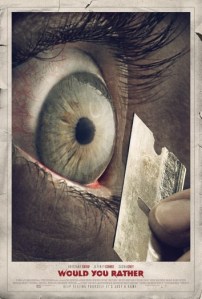
Would-You-Rather-354x525I’ve been wanting to write a review about this movie for a while, but I just didn’t have anything substantive to say about it, other than that it pushed a lot of good buttons. I’m a fan of locked-room horror, because it feels almost like a play. It evokes intimacy, then as things get more intense, claustrophobia. I also have a soft spot for adolescent games turned dark, which is why I liked TRUTH OR DIE and will probably love TRUTH OR DARE when it comes out next month.
The cast is also fantastic and varied, with Brittany Snow, horror alum Jeffrey Combs, Robin Lord Taylor, and Enver Gjokaj, plus a number of other familiar faces. Really, in dinner theater, there’s nothing better than bringing together an amazing cast, because even the small parts are given greater intensity.

(Side note: It also has a wonderful, subtle opening credit sequence that I love. Reminds me of the opening credits of MADHOUSE in terms of beauty and CABIN FEVER in terms of slow-burn subtlety—which was about the only thing in the original CABIN FEVER that was slow-burn subtle, by the way.)

On its surface, WOULD YOU RATHER is a simple sadistic tale in a post-SAW gorescape of bringing a group of flawed people into a space and making them torture each other. For WOULD YOU RATHER, though, a smaller budget makes the situations seem much more realistic in scope and execution and less of a spectacle. As gore goes, it’s minimal, playing off implication and imagination rather than showing the blood. Not that it goes easy on you.

The premise: Wealthy patron invites down-on-their-luck individuals for dinner for a chance to win a substantial amount of money. The exact amount is never specified, but it’s suggested that it will take care of all immediate debt and whatever else an individual needs to get back on their feet, and then some.

It doesn’t go well.

The reason I decided to finally write a review is that this small, scrappy little gem takes on a disturbingly relevant tone these days.

Haves versus have nots is an old conflict. Ever since we’ve had an economy, we’ve had wealth disparity and its resultant tension. But as wealth disparity grows and the poorer get blamed for it, that tension’s only going to get worse. As our present administrations continue to cut safety nets and entitlements, as health care costs soar, as student loans continue to burden the generations entering adulthood, as corporations continue to blame millennials for their own lack of wealth that makes the increasingly more expensive markers of adulthood out of reach, as affordable housing and decent food and other staples rise in price against stagnant wages…the tensions continue to escalate. Between the haves and have nots, of course, but also between each subsection of the have nots, because it’s an insidious strategy to pit the have nots against each other in the blame game so they don’t have enough energy to combat the haves. (See: THE HUNGER GAMES. Also: A BUG’S LIFE, which is unexpectedly political.)

And here we have a wealthy, white psychopath and his lazy, spoiled brat rapist son bringing debt-ridden people together to torture each other for their own entertainment…because they know they can. At the very beginning, we see the signs. In the doctor’s office where he courts Snow’s character to the dinner party, he’s eating either peanuts or sunflower seeds on the couch and discarding the shells on the cushion next to him. Not in a bowl, not in an ashtray, not in a tissue, not in a trashcan. He’s in a doctor’s office, discarding his trash on the furniture without any regard to the impact of his actions. We see where he’s put himself in the hierarchy.

The host laughs as he convinces a vegetarian to eat meat for ten thousand dollars. He laughs as he convinces a recovering alcoholic to drink a bottle of scotch for fifty thousand. In a world where one major illness can wipe out everything, where mental and chronic illness can make functioning to production standards impossible, where addicts are entirely blamed for their addictions when one moment of weakness shouldn’t lead to a lifetime of damnation just because of an exploited trick of brain chemistry, where being poor is so goddamn expensive while rich people get free things handed to them on the platter as though they’re lucky cats…blaming have nots for their own circumstances has become more unconscionable, yet the rhetoric seems to have only increased.

(In the interest of full disclosure, I’m a white millennial with the additional privilege of parental wealth. I’m still angry on behalf of friends who get shit on. And frankly, on behalf of total strangers, too. This doesn’t have to be personal and I don’t have to have stakes in the game for me to care.)

But here we have a self-made man who sees a table full of losers, who feels he’s completely entitled to do anything he wants, because he has the money and they want it and are willing to do anything for it. All they have to do is sacrifice everything. And even then, only the winner gets it. All of them will sacrifice everything, but the winner takes all. So you see, friends, if you just work harder… Never mind that luck plays a significant role in the game as well.

Suffice it to say, the movie feels far more allegorical than the first dozen times I saw it. Even the deaths and how each player relates to each other seems more significant. For instance, it doesn’t seem coincidental that the pretty blonde protagonist gets as far as she does.

Don’t get me wrong. She’s a driven young woman. And though she’s hardly the physically strongest person there, quite slight in stature in comparison with everyone but Sasha Grey’s character, the Lambrick Foundation chose her because she’s fighting for someone else, and that sometimes makes a bigger difference than fighting for yourself. Brittany Snow does a fantastic job leading the ensemble with her vulnerability, and it’s worth watching her reach the point where she changes from a scared, passive victim to someone determined to survive.

But it’s still a stunning lesson in privilege, presided over by a man with a Draco Malfoy-like son who thinks he’s superior because he was born into wealth by no effort of his own and, like his father, is bailed out of his own criminal activity, excused for it supposedly because of the trauma of his mother’s death. Yet somehow, he deserves his wealth more, and everyone else in that room deserves to sing for their supper until they die.

It’s a blistering indictment. It really is. When a dinner party turned slaughterhouse is a rich man’s solution for who deserves his charity (which, when it has strings, isn’t charity at all), when compassion doesn’t even enter the conversation, when dire straits are viewed as just deserts and help something you must earn at the cost of your life or someone else’s, something is seriously wrong. The one percent may not be putting people through such individualized, intimate torture, but it is actually a matter of life and death. People are dying. And on their potter’s field headstones, it might as well read: Should have bootstrapped harder.

In that light, easily the most chilling line: “You know, you agreed to be here. You’re basically asking my family for a handout. The least you could do, pig, is show a little fucking respect.”

Beyond the social horror, though, the low-budget torture goes back to the classics. Really, there’s no need for genius, Inquisition-level engineering. The standards are standards for a reason, and the impact isn’t lower because of the utter, beautiful, sadistic simplicity of it all. As the players submit to the deadly game in their own desperation and will to survive, you’ll be asked the same questions. “Would you rather?” stripped down is just “Under the right circumstances, what are you willing to do?” As countless unethical social experiments have shown, we’ll always be horrified by the answer.

Review: THE RUINS

21 Saturday Oct 2017

Posted by amandamblake in Movie Reviews

≈ Leave a comment

Tags

body horror, carnivorous plants, horror, movie, paranoia, review, the ruins

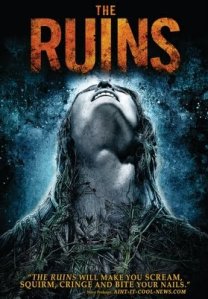
The RuinsThere were mixed reviews for this movie among friends and critics, but it’s one of my personal favorites, a regular go-to for a bit of character-driven body horror. The more I watch the movie, the more complicated it gets underneath the rather unoriginal, shiny exterior, which is why I feel The Ruins is seriously worth a horror fan’s time. As a shiny movie, it might also appeal to the non-horror fan, if they have the stomach for it.

Plants are a funny thing to make a villain, and I can see how some people might not go for the idea of carnivorous plants as something that can get your skin crawling, but it’s been a bit of a peripheral fear of mine. One of the shorts in the Creepshow anthology, the one featuring Stephen King as a simple-minded farmer baffled by a meteorite with a gooey interior that causes grass to grow on everything like a fungus has stuck with me for years—hits me again every time the parsley gets overgrown and starts trailing onto the porch.

Forests do get nutrients from death of both flora and fauna; creeping vines can infest and infect a whole grove; the fight for sunlight in rainforests is a brutal one; oils on leaves or thorns can cause serious damage or horrible death, all in the name of self-protection, and all without an as-yet demonstrable consciousness, which isn’t to say that plants don’t respond—which is the freakiest thing that I just said. We’re surrounded by plants, but too often, they’re just scenery or accessory to us, and that’s a mistake.

All that to say that, as much as I love my backyard and adore big trees and roses, I still find plants kind of creepy. So I can get into the mentality of villainous plants more quickly than some people. What can I say? I’m an ideal horror audience. (Not so much on board with the villainous vegetarians, but Trolls 2 is still worth a watch as one of the most awesome terrible movies ever made.)

After a cryptic prologue, The Ruins opens on a bunch of young, pretty twenty-somethings on vacation in Mexico—bikinis, alcohol, sun, sex, all pretty much the accoutrements of a typical horror movie, which is why it’s easy to think The Ruins is going to follow the usual, unoriginal punishing formula. Nothing new to see here, folks. Situation normal; all fucked up.

And as a trope, The Ruins definitely falls under the label of Tourists Behaving Badly. Or, more specifically, American Tourists Behaving Badly, although they’re tagging along behind a couple Germans and Greeks. It’s easy to roll your eyes when they flash money to do The Forbidden Thing, when one of the characters takes pictures of the Cute Locals in their Native Environment, and when the emergent leader of the group declares with absolute, desperate certainty, “This doesn’t happen! Four Americans on a vacation don’t just disappear!” People disappear all the fucking time, man, and not just on vacation. Naive affluent illusions, shattered.

However, though The Ruins works within the framework of a fairly typical twenty-somethings-suffer horror movie, it’s what the screenwriter (same as the author of the original novel, which I plan to read one of these days) and the director did within that framework that’s worth a second glance.

I don’t think The Ruins would have done so well without an exceptional cast. Shawn Ashmore is one of my favorite underrated actors (actually, I’m a fan of both Ashmore twins, and they both have feet in the horror genre). Jonathan Tucker is a familiar face in the genre, and he has a quiet, odd-faced, hard-bodied intensity to him that serves him well. Jena Malone is also a surprising force of nature despite her slim build. Sergio Calderon plays the lead Mayan, and he might be a face you recognize, but you don’t know from where. I think he lends some unexpected gravitas in a role where nothing that he says is understood, but his face and tone speaks volumes. There’s no weak link in the cast, although the script has some weak points that don’t do them any service. One of the best things about this film, though, is that whoever you think the characters are at the beginning, they subvert those expectations by the end, which is the marker of good storytelling.

The basic premise of the movie goes something like this: The tourists visit Mayan ruins that aren’t on any of the maps to meet up with a group of archaeologists. They trespass onto forbidden land and touch the strange vine that seems to grow on the ruins and nothing else. A band of Mayans who apparently protect the area around the ruins quarantines them there. As expected, they’re in the middle of nowhere, no cell service, no sat phone, no airplanes, little expectation of rescue. And they quickly discover that the original archaeologist team is dead and that the vine is responsible.

What follows includes unspoken tensions between the members of the group coming to a head, some brutal decisions about how to take care of the wounded in primitive conditions, and what to do about the vine spore that’s entered into those wounds and coated everyone’s clothes and skin. If you’re a fan of body horror, there’s some good, flinching gore for you, but it’s the human element that keeps the movie grounded in something almost paranoid. Some of the best horror, in my opinion, comes from the lengths we’ll go to when we’re desperate to survive.

I won’t spoil anything about the nature of the vines or the fates of the characters, but it doesn’t disappoint, though the unrated ending beats the theatrical (unrated version also has an extraneous scene, but I can forgive it). In a contest between The Ruins and Cabin Fever about horror getting under your skin, The Ruins beats Cabin hands down.

Review: FINAL GIRL

18 Wednesday Jan 2017

Posted by amandamblake in Movie Reviews

≈ Leave a comment

Tags

abigail breslin, alexander ludwig, final girl, homage, horror, meta, movie, wes bentley

final_girl_updated_posterThe best meta-horror works as both meta and horror (see SCREAM), and it’s hard to say how well FINAL GIRL reads to a viewer who isn’t a horror fan. As a concept – comely blonde teen girl plays vigilante to misogynistic killer teen boys – FINAL GIRL is not necessarily new, and we’ve perhaps seen it done better (see BUFFY THE VAMPIRE SLAYER). But that doesn’t rule FINAL GIRL out as a worthy addition to the female-revenge fantasy subgenre,  of which there will never be enough, in this horror fan’s humble opinion.

The film opens with horror known Wes Bentley (P2) interviewing a little girl after her parents died to determine whether she’s a good candidate for an unspecified Program where he’d train her for an unspecified Mission. The little girl shows minimal emotional distress at the death of her parents, indicating at least borderline anti-social personality tendencies to match the emotional detachment of the trainer in question, whose own state of mind is revealed to have traumatic roots.

Shift to little girl Veronica grown up in the form of another horror favorite Abigail Breslin (a standout in her first film, M. Night Shyamalan’s SIGNS). Taking a disaffected tack, Breslin and Bentley unsettle, but the viewer will eventually realize that the style continues throughout the movie – these detached, damaged loners are no more fully human than the young men they hunt. Takes a maniac to catch a maniac, and all that. But driven by Bentley’s characters compass of righteous violence,  perhaps we are meant to at least be glad they’re fighting for the right ‘side.’

It’s no coincidence that the director chose to film the whole movie in disaffected noir style, set vaguely in the 1950s but with cocktail dresses and suits from more modern times. The brief training sequences are set in a warehouse without a stitch of extraneous furniture – a chair here, a bed, concrete as a bunker and expansive as a warehouse, with a government-issued older man instructing a young woman (age indeterminate, as adept at appearing fourteen as twenty-five, though Breslin was around nineteen when the movie came out) in a black cocktail dress and undeniable and deliberately uncomfortable sexual tension driven not by the man but by the manipulative sociopath who has nonetheless bonded with her captor.

A less than hopping diner in unappetizing yellow/brown tones straight from a Hopper painting. Bright lights through the black forest as though the moon could cast such light and shadow, spotlighting victims in white and pursuers in suits as well as Veronica in predatory red and innocent china face.

Cue, blonde bait to the pack of wolves in 50s dialogue yet modern accent. My favorite part of the whole movie is when we’re introduced to the wolf pack gathering together to fleece the rabbit. We get beautifully noir images homaging Hitchcock and A CLOCKWORK ORANGE, among other notes I couldn’t distinguish. Exquisite use of light and shadow, which is true through the entire movie, but especially stylistic here. The movie might as well be black, white, and sepia except for Veronica’s red dress and lips.

Alexander Ludwig (Cato in THE HUNGER GAMES) plays true to type, and he plays it well, the gleeful sociopath – attractive, also blond, and the clever foil to our homicidal Girl Friday. SPOILER When he lights up at the sight of her in the woods during the hunt, after seeing what she’s done to his other boys, you truly believe he’s found a kindred spirit far worthier than his wolf pack compatriots, a much more appropriate love story than the one between girl and trainer (and still a better love story than TWILIGHT, jk).

I enjoyed the movie much better in my second viewing, perhaps because I could appreciate the style, which is net greater than the substance of the story. But aside from some underwhelming fight scenes (I think Breslin did most of her own stunts, and the lack of perceived power behind the blows shows and doesn’t quite work as choreographed violence like a dance), this little bit of meta-horror pays beautiful, disquieting, trippy tribute to the last girl standing.

Enter your email address to follow this blog and receive notifications of new posts by email.

NOW AVAILABLE

WHERE IT ALL BEGINS

TINGLE YOUR SPINE

Website Built with WordPress.com.

  • Subscribe Subscribed
    • Amanda M. Blake
    • Join 146 other subscribers
    • Already have a WordPress.com account? Log in now.
    • Amanda M. Blake
    • Subscribe Subscribed
    • Sign up
    • Log in
    • Report this content
    • View site in Reader
    • Manage subscriptions
    • Collapse this bar
 

Loading Comments...