• About the Author
  • The Thorns Series
  • Short Stories/Poetry
  • Standalone Novels/Novellas
  • Content Warnings
  • Media/Reviews
  • Contact

Amanda M. Blake

~ Of fairy tales and tentacles

Amanda M. Blake

Category Archives: Movie Reviews

REVIEW: The Wolfman (2010)

31 Monday Dec 2018

Posted by amandamblake in Movie Reviews

≈ Leave a comment

Tags

beasts, benicio del toro, horror, id, jekyll/hyde, monsters, movie, review, werewolf, wolfman

wolfman coverWOLFMAN, the remake with Benicio del Toro, is one of those movies I keep watching in hopes that I’ll like it more. And to be honest, I do like it better than the first viewing, which is often the case for movies I enter into with expectations. There are certain things I want from a werewolf movie, and I’ve thus far been pretty disappointed with most of them.

Perhaps because werewolves don’t really seem to translate well on screen. I think the best I’ve seen so far were from UNDERWORLD, which in itself is a fun and pretty but not very good movie. But the werewolves were ones I believed, and in my opinion they were appropriately bestial and intimidating. In movies I’ve seen where the wolves were just giant wolves (like the TWILIGHT series), they suffer from being noticeably CGI or noticeably puppets. In movies where they’ve been more anthropomorphic and built around a human form, they just aren’t that frightening to look at. I’m not sure what it is. Is it the wet nose? I’m just not sure what it takes to make werewolves frightening to me, so maybe the answer to that is they should stop trying. As werewolf movies go, THE HOWLING is probably best, disjointed though the editing is. It really encapsulates the horror of the transformation and animalistic nature of the beast, and it covers how becoming a werewolf might bleed into the human life.

But I suspect that, despite all the fairly standard sex that seems to fill our screens in R-rated movies, we’re still quite shy about sex, and a person giving into their id just makes our Puritan little hearts nervous. You can’t turn a man into a beast and then cut his balls off and expect us to be intimidated by what he’s become–and more importantly, what’s in all of us. Which is supposed to be the real horror, I suspect: the Beast in us all. But where most books seem happy to detail the daily depravity we’re capable of in werebeast and human form, movies skirt around the worst of it whenever the id has to take shape. I think they worry we’ll be too shocked, I tell you, shocked, and they want a broader audience to make a broader amount of money. But that’s neutering the beast, and it just ends up not working quite the way it should.

THE WOLFMAN is no exception, although the cast is fantastic and the devotion to detail in setting, costume, and atmosphere admirable. The movie is awash in fur coats and stuffed beasts from the elder Talbot’s hunting days. The Blackmoor manor is strewn with leaves and shadows as though the wilderness is slowly taking over its palatial splendor. The palate runs a respectable moorland gray, and the movie isn’t lacking in bright red for the R rating.

But the movie suffers from a lack of identity, although del Toro takes on the Talbot role with the same bushy-browed, soft-featured intensity of Lon Chaney, Jr., in the original that would likely have made him proud. Anthony Hopkins is a delight in every mediocre role he takes. The first few viewings, I was sure he was phoning it in like he did in THE RITE, but subsequent viewings give me a chance to take in his more subtle choices. He latches onto every line with a sometimes quiet and sometimes growling ferocity. He commands every scene he’s in, which is why the man is an international treasure, despite the less than adequate meat in this movie to chew off the bone.

Emily Blunt, I believe, is the actor most ill used by a movie that doesn’t know whether it wants to be tragedy or horror. (WOLFMAN mostly goes with tragedy with bloody dashes of horror, but the joke’s on them, because good horror makes tragedy all the more intense.) Blunt is too good for the role, put into the movie as a shining beacon of perfect Victorian femininity, a bastion of purity that no beast should sully, a love more romantic from afar, an ideal rather than a woman. It’s disgusting in such a male-heavy movie to make the only woman such a representation of an abstract. Ideals are all well and good, but what people in a society ever really live up to them, especially in private? We wouldn’t need such strict rules and chaperones if people weren’t trying to break those rules at every turn.

At the beginning, Talbot calls a man’s character “a shiftable thing,” a statement clearly intended for the dramatic irony, but the sheer fact of the matter is that THE WOLFMAN doesn’t work because Talbot’s character doesn’t shift enough. It barely seems challenged by new appetites. He’s briefly distracted by Blunt’s bare neck (honestly, who wouldn’t be?), and dreams about a naked back. So salty. So animalistic. So…tame. Talbot mostly remains the mild-mannered man except when he is beast, when the point is supposed to be that Edward Hyde is Dr. Jekyll. Jekyll/Hyde stories tend to do werewolf better than werewolf movies – the Spencer Tracy version is superb and is one of the movies to better show Hyde’s glee, but it really plays up the good vs. evil that isn’t what the original story set out to tell. Instead, for an excellent werewolf tale, I actually recommend Jekyll/Hyde movie MARY REILLY with Julia Roberts and John Malkovich, which is a criminally underrated movie, if not necessarily a masterpiece (really, if you ignore the bad accents, it’s quite good). Like Bruce Banner said, he’s the Hulk because he’s always angry.

If the beast doesn’t exact the worst impulses of the man and if the man doesn’t exhibit the worst impulses of the beast, what’s the point of a werewolf movie? What the point of the blood and drama and confusion? If the presence of a werewolf doesn’t strip away the patina of respectability of all around him, you’ve missed the point.

I’m not saying I needed a Talbot/Conliffe sex scene to satisfy my own worst impulses (although I wouldn’t say no). But Talbot shows early nods to resentments, a festering anger from his childhood against the town, against his father, and a desire for his brother’s fiancee, none of which I feel come to a head in any real way once the transformation occurs. Was he supposed to seem virtuous for retaining his self-control? Is it to contrast with his father, who is, in his own words, more comfortable in the skin he is in, while Lawrence makes a living pretending to be other people? We get the glimpse of the wicked in Lawrence’s father, his willingness to allow himself to feel his baser nature rather than repress it, although he still retains some self-control while a man.

I just wish there was some transformation on the character level for Talbot to parallel the transformation on a supernatural level, that he didn’t only give in to the beast when the moon was full, that it infected his personal life in more interesting ways. Instead of the beast being an extension of him made manifest, it remains distant, the actions that of an animal rather than an id. I don’t think he would have seemed less tragic for the loss of control of his impulses–after all, he didn’t choose to be bitten, to have to fight harder against those impulses. He was paying for the sins of the father, which is never fair. Del Toro is perfectly capable of treading that line. In the one moment where the beast threatens to overtake Talbot in the presence of Conliffe, though he doesn’t do much, he’s frightening and alluring at the same time, wonderfully intimidating, and Blunt plays off that with a quintessentially Victorian response belied by the scared intrigue in her eyes. That moment is the closest I have to what I want from their dynamic, and it’s delicious. But it pulls away too quickly and never again treads near the same level of tension between man/woman and the beast in both, though brought to shallower waters in the man.

More than anything, the restraint shown by the script and the direction seems more a product of the idealization of the love interest, the sole female presence in the film–although the ghost of Talbot’s mother seems to hover over everything. As though a woman’s own red tides of anger, frustration, fear, grief, and lust would somehow mar her if it cracked her pretty portrait of a face. Moreover, I believe there’s a genuine fear underneath most werewolf movies of the beast that exists within women as well. Not just the female villains (most masculinized or hypersexualized or both into unrecognizability of what women experience every day). Not just the disposable, nameless, dehumanized prostitutes that we keep killing off like so many victims of so many Jack the Rippers. The Beast in us all.

I’ve seen one movie that didn’t seem afraid of freed, unfettered female sexuality. The remake of DRACULA (also with Hopkins, in a role he seemed to have much more fun in) may have just been Francis Ford Coppola’s feverish wet dream for most of it, but it’s one of the few movies I know of that seem to unapologetically acknowledge women’s lust in supernatural situations. Yes, much of it is downright shocking for this generations-removed Puritan, but quite refreshing as well when set against a slew of horror movies that are unapologetic in the amount of boobs they show yet somehow afraid of a woman actually enjoying herself in the midst of a fairly rigid social expectation that they don’t. If that’s the excuse why they kept Miss Conliffe the Victorian ideal, I’m pretty sure Lucy Westenra spits on that. If the point of werewolves is that there’s a beast in us all, the refusal to believe there’s a beast in Miss Conliffe seems the worst kind of oversight. It may have been unintentional, but it’s frustrating nonetheless.

If THE WOLFMAN is soft on sex, it certainly isn’t on violence, which is one of the movie’s only saving graces, although I would have preferred more substance and less flash to the chase scene in London. CGI is supposed to be a friend, not a lover, and it doesn’t work nearly as well as studios depend it will. But I have to say, the level of detail applied to the transformation scenes was professional as hell and believable, even if the final product loses some of that believability they put into the shifting. Still, the werewolf’s attacks are vicious, merciless, that of an angry mother grizzly, and it’s pretty spectacular as it’s happening.

But in the places between the transformations, the movie just seems unsure what it wants to do and where it wants to go. It’s the movie version of telling rather than showing, and though I’m inexcusably fond of asylum horror, THE WOLFMAN doesn’t linger there long enough for me to care as much as I want to about the hubris of doctors. It brings to mind DRACULA again (see Jack Seward’s asylum). WOLFMAN fails in almost every comparison with its classic Universal monster movie counterpart, even that of the beasts that the eponymous monsters become. The only place where it seems to shine more than DRACULA is in the sets and the cinematography, which is more a product of when the movies were made than a failing on Coppola’s part in his DRACULA.

It’s really a shame, because I want to like this movie, and like THE LAZARUS EFFECT, I think I keep watching it for the movie it could have been. It’s occasionally a decent script, and del Toro, Hopkins, Blunt, and a somewhat typecast but still devoted Hugo Weaving make the best of where the script weakens.

I just have Thoughts about what werewolves are in the pantheon of horror monsters, and I feel like the movie makers really missed the boat on this one, as they usually do with this particular monster. Almost as though they’re afraid to look into a mirror and really see themselves. They tend to do well with vampires, but with vampires, they don’t have to see their reflections.
REVIEW: Silent Hill

31 Wednesday Oct 2018

Posted by amandamblake in Movie Reviews

≈ Leave a comment

Tags

alice krige, female-led, halloween, hellscape, horror, jodelle ferland, laurie holden, movie review, radha mitchell, sean bean, silent hill, video game

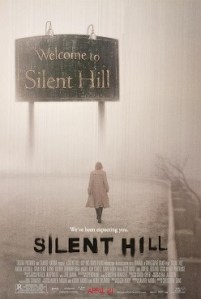
Silent_Hill_film_poster[Warning: Here there be spoilers]

I agonized over what movie I would review for Halloween. I wanted it to be one of my favorites, one I really liked. The Descent? A 1408/Oculus double feature (because yes, they go together)? American Mary? Candyman? I ultimately decided on Silent Hill, one of the first movies I saw during my freshman year of college, when I started watching R-rated horror and really got on the horror train. (Yes, I waited until I was seventeen. Yes, I am that person.)

In the interest of full disclosure, I’m prone to really like my early introductions to things, because that’s before I get jaded. But despite the fact it’s not a perfect film, Silent Hill was surprisingly good, especially for a video game to movie adaptation. Although from what I hear, if you’re going to do a VG2M horror adaptation, Silent Hill is the one to go to. I’ve never played the games myself. I’m too prone to habitual behavior for me to trust myself around video games. So I don’t have any expectations of someone who’s played the game, but the movie pushes so many of my personal buttons. It wasn’t a critical darling, and I can tell why. It’s monster-dense, melodramatic, and as stories go, not very original. But for me it’s less about originality (although that’s nice, too) and more about execution. It may be derivative, but is it a good story? Am I entertained for the night? Am I satisfied? Can I watch it over and over and over again and never get tired of it? Silent Hill is one of those films for me.

This is as much a contemplative retrospective as it is a review. Okay, it’s just me rewatching the movie and geeking out. Bear with me.

One of the most wonderful things about this movie is that the cast was originally so woman-heavy, they had to give Sean Bean a somewhat extraneous side plot just to make men feel included. And it’s one of those rare Sean Bean roles in which he doesn’t die, so… But the movie is a powerhouse of female roles with actresses known for genre films. There is absolutely nothing wrong with this.

Despite being a generally misogynistic genre, horror also historically has these huge, powerful roles for women, especially with the Final Girl trope. But Silent Hill and The Descent, both movies with a majority female cast, are both in my top ten list of favorite movies, with layered, nuanced characters and all different kinds of strength. What’s more, while many of these women are sexy and beautiful, because Hollywood, the movies and their strength don’t derive from those qualities. Or rather, to me, the sexiness comes from the fact their strength isn’t from sex but from character and determination, if that makes sense.

We begin with Radha Mitchell, who is a wonderful, solid leading lady. One of the things you might keep an eye on in subsequent viewings is how her main outfit changes over the course of the movie. It’s supposed to be the same outfit, but the colors subtly change from scene to scene to fit the hue and mood and transitions during the movie. Props to the costume department for coming up with so many forms of the same outfit and making it feel seamless. (Another trivia side note, this is supposed to take place in West Virginia, but it was shot in Canada, which means a certain percentage of the cast needs to be local, so there are all these Canadian accents here and there. It’s a little hilarious, especially when the script has more regional dialogue.)

Mitchell’s character, Rose, and Bean’s character, Christopher, are searching for their daughter Sharon, who’s sleepwalked far from home, screaming “Silent Hill!” when they try to wake her up. This prompts Rose’s research into her adoptive daughter’s origin in the ghost town Silent Hill–a former coal town rendered uninhabitable by a fire–and her plan to secretly take Sharon to Silent Hill to see why she has these terrible night terrors and somnambulism episodes.

Seems like a wonderful plan.

Sharon is played by at-the-time child actress Jodelle Ferland, who’d already dipped her toes into horror by the time she did something as mainstream and big budget as Silent Hill. She was around ten or eleven during filming, and she was still a small girl, but some of her lines suggest that she was supposed to be playing younger, and it doesn’t always land well, maybe because she’s using a little girl voice in her higher register to contrast with the lower Alessa voice. She’s a convincing kid, but there’s a maturity to her that doesn’t really fit the age I felt she was playing. It works when she’s Alessa but not always as Sharon. Still, there’s a reason this girl keeps playing the devil. She’s very good at old-young, which is part of the reason she’s one of the inspirations behind my Snow White character, though she’d now be too old for the role. Nevertheless, her work in Silent Hill has led to me watching her career, and I’m rooting for her as she transitions into adult roles.

But I’m getting ahead of myself. One semi-abduction, police car chase, and car crash later, Rose wakes up on the edge of Silent Hill, surrounded by dense fog and ash floating from the sky like snow. Since I’m not familiar with the games, a lot of these atmospheric elements are new to me, and extremely effective. It’s a beautiful, muted visual. I’m a sucker for pretty horror, and Silent Hill has a lot of pretty and ugly-pretty horror for my needy little eyes. Among all the ash, Sharon is nowhere to be found, thus beginning the scavenger hunt portion of the movie.

I’m being flippant, but it’s actually a good conflict–mother seeking daughter and willing to do anything to find her and keep her safe–and that conflict plus a lot of what follows pays plenty of homage to the video games without feeling too much like one. Finding what’s lost is a classic video game device, and it works just as well in more linear storytelling. It’s basically an ‘into the woods’ quest, with all kinds of monsters and allies along the way.

Once in Silent Hill, Rose quickly discovers that this town is not normal. In Ash Mode, it’s just haunting, unsettling. But Rose follows what she thinks is Sharon into a warehouse. That’s when the emergency siren goes off, and the Ash world flakes away to reveal a hellish interior. It’s a pretty, darn good effect, and I’m not usually a fan of CGI. In Hell Mode (or Rust Mode), that’s when the monsters really come out to play. In the warehouse, it’s the Gray Children, which look like misshapen burning babies. Here’s where the CGI loses it a bit for me. People should be people whenever possible, because anything less than the best motion capture doesn’t move like living things actually move. In the special features of the DVD, I watched the green screen where a small female contortionist donned her Gray Child costume and moved around in it, and that’s honestly creepier for me. Upon another viewing, I think it’s because the proportion of the Gray Children to Rose keeps changing, which jars me out of the suspension of disbelief. However, the Gray Child was my least favorite CGI monster in the movie. All the others are better.

(When the Gray Children scene ends with everything flaking back into Ash Mode, Johnny Cash’s “Ring of Fire” plays on a jukebox in the bowling alley. Everyone in the original theater laughed; good release of tension, and the only funny bit in the movie.)

After the more neutral Ash Mode (I’m sure there’s an actual name for these modes in the video game, but I don’t want to look them up at the moment) returns, Rose runs into Dahlia, a Miss Havisham-meets-Cassandra type character in the movies, although I understand she’s more of an antagonist in the games. Here, she’s the sorrowful mother, a broken woman heavy with cobwebs, dust, and regret, played by the gently altoed Deborah Kara Unger. She chews the scenery in a wonderfully maudlin way and gives us the first bit of exposition about Alessa, the child that was taken from her. When Rose shows her a locket with Sharon’s picture, Dahlia becomes agitated and insists it’s Alessa, her own child.

As Rose continues to look for Sharon and for a way out of Silent Hill, which seems completely cut off from the rest of the world–literally, with the streets out of town broken away and nothing but an abyss on every side–she runs into the cop that chased her into the town, Sybil Bennett, played by genre royalty Laurie Holden.

From what I can tell, people either love her or find her annoying. Silent Hill was my first introduction to her, and I won’t lie. When she first pulled off her helmet and started shooting at the Armless Man (much creepier than the Gray Child), I developed a serious crush on this woman, hardass cop notwithstanding. Sure, it seems ridiculous to us for Cybil to handcuff Rose with everything that’s happening, but as far as Cybil knows, she’s followed a parent kidnapper into Silent Hill, and it wouldn’t be the first (which is a nod to one of the games, apparently).

At this point, the Sean Bean side plot makes it perfectly clear that the ashy Silent Hill isn’t just cut off, it’s a completely different dimension existing parallel to the real Silent Hill, where it’s pouring down rain and police are searching for Rose, Sharon, and Cybil. Through the inspector on the case, we’re given a little more exposition about what happened to Alessa and to the town. But on their side, it’s just a normal ghost town–singed, smoky, dangerous due to the coal fires still burning and sending fumes up to the surface, but otherwise normal. When Rose is at her most distressed, Christopher senses her, which leads to a so-close-yet-so-far moment that I think played pretty well. Extraneous though it may be, I feel like the side plot does provide a much-needed atmosphere respite from the fantasy-horror Silent Hill world. The doses of reality offer enough of a contrast that the hellscape seems all the more hellish.

Rose follows the clues left behind for her by the child she keeps thinking is Sharon running away from her, all the way to a school marked by a curious-looking cross. Inside, there’s evidence that Alessa was decried as a witch even by the children and that something obscene happened to her by a janitor named Colin, given what this hell universe tends to do to the people who hurt her. Colin is dead, wrapped and contorted with barbed wire, and in his mouth is something Rose needed to find, a hotel key. But before Rose can leave, she discovers men in coal miner gear outside the bathroom. Their canary goes crazy right before the emergency siren goes off and Hell Mode returns, bringing Colin’s dead, desecrated body to life.

This is one of those cases where practical effects really paid off, and it’s no wonder that the same man who plays Colin is also the one who played Pyramid Head. He does amazing pantomime work, conveying so much with body language in roles where he doesn’t speak. Just as Pyramid Head is a pretty undeniable symbol of uniquely male violence (noticeable especially within a majority female cast), his Colin is a tortured obscenity. The artistry in his dual performances is a pleasure to watch.

With the cockroach-like Creepers and Pyramid Head after her in the rusty, bloody hellscape, Rose finally meets up with Cybil again, who can’t deny there’s something rotten in the state of Silent Hill. As soon as Ash Mode returns and most of the monster danger is gone, they continue following the clues the girl who looks like Sharon left behind, all the way to a hotel. The music they use on their way reminds me that I love the soundtrack of the movie, which borrows themes from a number of the games. It’s a great industrial sound that translates well to the movie.

At the hotel, we finally get a good look at Alessa, who’s the spitting image of Sharon except for the dark hair and school uniform. And we meet one of the first fundamentalists left over from the fire. They’re a sect off of Christianity, with theology built around witch-burning and maintaining purity in the community. In the case of Anna and most of the other members of the congregation, this is where the story tends to turn overwrought and overly simplistic. The only grounding influence is the cult leader Christabella, played by the wonderfully hypnotic Alice Krige, another member of genre royalty. Have I mentioned how stellar this cast is?

And how unique is it that this fundamentalist cult is run by a soft-spoken, steely woman instead of a charismatic man? What could have turned into something laughable is given a more solid foundation by Christabella, who is clearly a true believer of her own religion (also unusual in cult movies, where the man is clearly a con using his charisma to gain power and respect). She may be an antagonist and an evil person, but I respect true believers more than cons, and she has no reason to believe she’s wrong–after all, their people have remained safe, and the church remains a refuge from the darkness whenever Hell Mode settles over the town.

This fact alone raises a number of questions for me that are never answered. It’s clear that if Alessa hadn’t been burned as a witch, Silent Hill would never have been sucked into a hellscape by the demon that Alessa accepted inside of her, so Christabella is clearly the author of her own people’s destruction. But it’s curious that people portrayed as evil, as those who have twisted faith into something ugly and vicious, can still keep the demon at bay in their church. It’s curious that the church is still a sanctuary from the darkness. Demon!Alessa calls it ‘blind conviction’ that keeps her from entering, but is it really? Or does their ugly faith come with enough good intentions that it affords them some protection? Why would a demon not be able to enter everywhere in her own hell? Is their illusion of protection as much a part of the hellscape as their illusion of righteousness? They certainly don’t seem to be happy with either.

So many questions unanswered, but I’m not one to think that something a plot hole just because it doesn’t have an answer. I’d like to think that things are more complicated than good and evil, even in heaven and hell.

Once in the church, Rose and Cybil are questioned by Christabella, but despite some reservations and suspicion on both sides, Christabella agrees to take them to where the demon waits and might have answers about how to find Sharon. However, when Christabella discovers that Sharon looks like Alessa, she tries to stop the two women. Cybil sacrifices herself to the fanatics to let Rose continue down into the center of the hellscape, where we encounter the sexiest of the monsters, the iconic Dark Nurses. This is one of the places where the movie feels more like a video game, but it doesn’t suffer from comparison. Instead, it helps build the tension, and the fact that all the nurses are made-up people really helps bring the realism to the moment that too much CGI would have destroyed.

Then we enter the realm of pure exposition where we learn the full story behind Alessa, Sharon, and what happened to Silent Hill. We still have questions: Why does the inspector look the same thirty years ago as today? Who’s Alessa’s father? Why was some of Silent Hill sucked into hell and not everyone? How much of what the demon says can we believe? And again, why can’t the demon enter the church without being brought in? What caused Silent Hill to become a ghost town–the fire that burned Alessa or the demon sucking most of Silent Hill down into its hell? Because I originally thought it was the fire, but Alessa was put into a Silent Hill hospital. Ghost towns don’t happen overnight, but if the fire caused the coal mines to burn, one would think it would have been pretty quick. Maybe these answers were lost in editing. They’re ultimately irrelevant to the story, but curious minds still want to know.

The story reaches the climax back at the church, where the fundamentalists–miserable, judgmental murderers that they are–receive what seems like just deserts. The only quibble I have is Christabella’s fate, which seems gratuitously sexual to me. Don’t get me wrong, the whole movie is graphically violent, sometimes beautifully so. Brutal beatings, a woman skinned alive, torture totems, the burning of Alessa and Cybil, the Dark Nurses… I just felt that Christabella’s fate could have been more poetry and less rape. Please.

The weakest parts of even good horror movies tend to fall at the end. Sometimes I like Silent Hill‘s ending and sometimes I don’t. Ambiguity is a horror movie maker’s friend, but it often leads to a frustrated audience. Then again, a solid, safe ending can hit a supernatural rather than a horror note, which can be a bit jarring, and a dark ending can be kind of despairing. It’s really difficult for horror movies to win.

TL;DR: Silent Hill is a badass, female-dominated, visually horrific and stunning movie–far from a masterpiece, but in my opinion, a solid offering and one I don’t mind rewatching on the regular. The sequel, Silent Hill: Revelation, is a hot mess. I enjoy it and it has some good moments, but it’s a mess. I feel like a good Silent Hill sequel could be made, but I doubt it ever will. The original manages to stand strong, strange, and horrifying all on its own.

REVIEW: The ReZort

20 Saturday Oct 2018

Posted by amandamblake in Movie Reviews

≈ Leave a comment

Tags

horror, movie review, the rezort, zombie

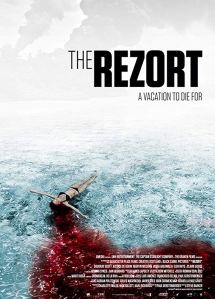
The Rezort[Warning: Here there be spoilers]

THE REZORT was one of those movies I didn’t expect much from, and I ended up getting a lot more than I thought I needed. I’m not sure whether the premise of the movie is original, but if not, I’m surprised it hadn’t been done before, because it made so much sense as a concept.

Basically, JURASSIC PARK meets zombies. And it’s surprisingly decent.

Great? Not so much. There are parts of the movie that seem far-fetched, although my threshold for disbelief is a lot lower than it used to be. Whenever I tell myself there’s no way anyone’s going to let a multibillionaire build a resort on an island where people can shoot zombies, I look at the world today, and I go, “Nope. There’d be protests and marches and debates, then they’d totally let her do that.” We have game preserves and hunting trails all over the world, dead people wouldn’t legally be considered people, and it would boost a post-apocalyptic economy. You think some of the lines in the movie regarding why the ReZort was allowed to happen are kind of ridiculous until you really start to think about them. Then you realize all the rhetoric is of the kind used in a number of other controversial but totally legal practices. Zombies aren’t real, folks, but if they were, it wouldn’t be too long before something like this happened.

There are parts of the movie that play a bit rote, with a cookie-cutter selection of side characters introduced to us: the immature gamers, the long-suffering soldier who misses the war, the pacifist-activist, the loving couple, the obnoxious businessmen, the evil billionaire. And these characters are put into a predictable string of zombie situations. I mean, it’s the ReZort. It’s a zombie theme park. You know it’s going to go wrong because you’ve seen JURASSIC PARK, and you know how it’s going to go wrong because you’ve seen at least one zombie movie in your life, and with few exceptions, they’re all really similar. But the actors bite into the meat of their roles, approaching the movie as though it’s more than it is, and so they make it that way.

Our main character Melanie is played by actress Jessica de Gouw, who’s on my celebrity doppelganger list as the spitting image of Rachel McAdams. I’d call her a poor man’s Rachel McAdams, and when I first saw her in the movie, that’s what I thought I’d be getting, but her acting chops hold their own. Come on, Hollywood, there’s a long-lost twin story in there somewhere.

We come into the movie post-zombie-war, when the world has fought its way back to something approaching normal due to a policy known as Operation Brimstone. In short, they firebombed the hell out of anywhere the zombies arose, which took a lot of innocent lives along with them and left thousands upon thousands of people without homes, causing a serious refugee crisis. The movie opens with a series of maddeningly realistic news clips from partisan channels bringing us up to speed on 1) what happened and 2) where the post-zombie-war controversies are. There are a lot of traumatized people. War equals trauma, and zombies equal personal trauma. There are soldiers adjusting to civilian life, because of the aforementioned war equals trauma. There’s the refugee crisis that’s moving at a crawl.

There are also people who challenge Operation Brimstone as causing too much collateral damage and those who challenge the concept of the ReZort as being callous with the dead. As activist Sadie points out, “If this is how we treat the dead, who’s to say the living won’t be next?” It has roots in pro-life and animal rights activism, but it doesn’t firmly hang its hat with either. It’s not a stretch to imagine how dead rights activists might address the zombie issue. After all, these are people’s families and friends that they watched change, sometimes right before their eyes, and it’s a moral and ethical dilemma what to do with them (and depending on spiritual views of life after death and how to treat dead bodies, it could be a religious dilemma,too). Like I said, personal trauma.

Melanie, who’s part of a post-zombie-war grief support group, and her ex-soldier boyfriend agree to go to the ReZort, a luxury hotel and game trail for people who want revenge on the zombie virus that upended their lives and killed their family and friends. Apparently, the controlled circumstances did wonders for someone else in her group, and she thinks it might serve her PTSD to indulge in some R&R and carnage—confronting her fears, but with cocktails.

Among the other resort guests, we also have a scowly, steely-eyed Dougray Scott, who most mainstreamers know from EVER AFTER, but who’s made something of a name for himself in the horror genre as well (hello, HEMLOCK GROVE, you pretty little mess). If anyone else is a significant actor, I don’t recognize them.

Their time at the ReZort begins with evening drinks by the pool, where the billionaire creator of the ReZort comes out and addresses her crowd. She’s definitely not what you expect, not least because the person who created an island retreat for zombie hunting is a woman. She’s trim, fastidiously neat and polished, like the owner of a tropical paradise hotel rather than one with a gruesome underbelly. She contrasts strongly with the zombie woman they bring out, shackled, dirty, and decayed. They stare each other down face to face (I’m pretty sure there’s enough slack on the shackles for the zombie woman to reach her if she lunges, but whatever), and it all feels exploitative as hell, especially since the zombie still has some soul in her eyes, although she acts like an animal. Everyone else is raucously cheering—”Every apocalypse deserves to have an afterparty!”—but Melanie’s clearly uncomfortable with how human the zombie still appears to be.

There’s only one other person there who seems just as ambivalent, the pink-streaked jilted fiancee supposedly there because the tickets were nonrefundable. But during the party, Sadie sneaks away to where she doesn’t belong and downloads some files in a personnel-only part of the resort. Because if everything went as planned, it wouldn’t be much of a movie.

The point at which everything goes wrong is where the movie is at its most predictable, and where it tends to falter. I would have liked to see more ReZort amenities beyond one day shooting at herds or at zombies set up in an abandoned compound like the guests are playing a real-life video game. What other sick ways do they use the dead? But there’s a twist toward the climax that I really like, because it’s just so awful and fits right into the post-Z world they’ve created, addressing an issue that you probably figured out already. I’m terrible at predicting twist endings (I’m getting better, which of course makes movies worse, so it’s a double-edged sword), and I didn’t see this one coming. Even if you do, it’s perfect enough to work.

Like I said, THE REZORT isn’t great. But when you turn it on just expecting the usual, getting the taste of a pretty darn juicy concept might just give you the popcorn evening in you’re looking for.

REVIEW: Slender Man

29 Saturday Sep 2018

Posted by amandamblake in Movie Reviews

≈ 1 Comment

Tags

bogeyman, haunting, horror, movie review, slender man, slenderman

slender man

I went to see SLENDER MAN with a friend, and like most people who saw it, I was extremely disappointed. Of course, it didn’t help that opening night audiences tend to be the most unpredictable. There are always rude people, but you never know where they’re going to sit. The couple sitting next to me were eating complicated food, so in the middle of a movie that’s densely dark most of the time, they had their phone lights on to see what they were eating. Bright lights. Dark theater. Dark screen. The light glared out the darkness, and this little magpie is easily distracted by bright, shiny, moving objects. Did. Not. Work. Who freaking does this?

I’m not somebody to call people on their bullshit, because I’m short and meek and not prepared to follow through if the other people get aggressive. But man, I just kept getting more and more annoyed. Then the guy next to me kept checking his phone even after they finished eating, and when he stopped, he eventually started snoring. Just… *choking gestures*

Even without nightmarish neighbors, SLENDER MAN fell far short of its potential. After the theatrical viewing, I was a bit confused, because I’d had the sense after watching the trailer a few months earlier that the movie would go in a much different direction. I re-watched the trailer again, and it definitely telegraphs a different storyline and some more violent moments.

It makes me think that the backlash to the trailer because of the ‘based on true events’ exploitative nature of the movie caused the showrunners to take their movie in a different direction–changing in edits, perhaps some script rewriting and reshooting. I’m not sure where they were in production at the time of the trailer, and I’m not sure whether the original story would have been more than a decent but forgettable movie. But from what I can tell, if they did significantly change the film, they changed it into something not as good.

Slender Man has been Internet creepypasta for roughly a decade, created out of nothing to become something of a meme. That’s not a long life for a viral monster of this kind, but he’ll probably stick around much longer, because he’s an amalgam of several iconic, creepy images and references similar creatures through history–from the Tall Man who was supposed to be the devil, to the faceless Bogeyman, to the Gentlemen from BUFFY THE VAMPIRE SLAYER, to the Men in Black (not the comics/movie, but the archetype), and perhaps the closest analog for me, the Terrible Trivium from THE PHANTOM TOLLBOOTH. Too-long limbs and facelessness are creepy and there’s really nothing new about him, hence Slender Man will probably stick around the Collective.

He was ripe for a movie of his own eventually. The problem, it seems, is with the timing.

The controversy of this movie comes from the fact that just four years ago, two twelve-year-old girls stabbed their friend (who fortunately survived). They claimed they did so to impress Slender Man and were sentenced to a mental facility. By violent, personal tragedy standpoint, there was probably never a good time to make a movie off of this, but since Hollywood is no stranger to exploiting tragedy for a dollar, I think a general rule of thumb is waiting at least ten years out of respect. But they would have started filming SLENDER MAN within two to three years of the attack, and it was put out four years later, which goes under the heading of Too Soon.

And technically, the concept of SLENDER MAN has been around pretty long in a netscape, so it might have actually been too late to capitalize on the viral nature of this particular creepypasta. Too late for viral, too early for tragedy.

The problem with having to weigh the real tragedy with what they were able to do in the fiction was that something a little closer to actual events, which is what the trailer hinted at, would have been a much better story. What’s creepier, a standard supernatural stalker film where you barely see the haunting? Or Slender Man actually inciting violence, both against the teens’ will and/or in accordance with it, and causing genuine insanity, not some poor imitation? (True, we learn something about one of the characters at the end, but it was a case of too little, too late, and too confusing.) In other words, if SLENDER MAN had been a bit closer to SINISTER or THE PULSE, it might have been salvageable.

As the movie ended up, it’s a mash-up of the supernatural-Bogeyman-stalking-friends element of the NIGHTMARE ON ELM STREET remake and the ghost-in-the-machine element of THE RING, while falling short of both. I’m actually a fan of the NIGHTMARE remake, which is a bit verboten to say, although I don’t like it more than the original. And THE RING is one of the best modern horror films (wasn’t a fan of RINGU, so I probably deserve to be drawn and quartered again).

If you’re going to put a creepy video in your movie that triggers the whole haunting like a net version of THE RING video, maybe you should make it actually, um, creepy. THE RING video benefited from being truly unsettling in its simplicity, with something as plain and stark as a wooden ladder on a wall alone giving a serious American Gothic vibe. The SLENDER MAN video is just a series of subliminal images, none of which are creepy on their own, and some of which go by so fast you don’t have time to get unsettled. If you’re going to invite comparison, you better make sure yours measures up.

As a concept, I feel like they had something that could have been interesting to work with even within the story they created. In their flimsy mythology that expanded upon the creepypasta, SLENDER MAN was an other-dimensional entity so strange to our dimension that to come into contact with him could change your perception, even cause a person to go mad. And they kept hinting at it happening, but aside from a few trippy moments (the library scene stands out as a respectable perception distortion, although I wish they would have done something less trippy and more creepy), they missed so many opportunities to play on paranoia and hallucination and instead got too attached to character denial and ineffectual effects. No madness. Not enough violence. Not enough paranoia. Not enough unsettling. You want an excellent example of slipping into madness that may or may not be real? Look no further than a movie that came out earlier this year, HEREDITARY.

Instead, there were a lot of plot details that padded the middle but never went anywhere. Cuts, edits, and rewrites obscured the original momentum and arc of the story to the point of meandering pointlessness.

There was proof that Annalise Basso’s character was obsessed with SLENDER MAN. And Basso is wonderfully disquieting in an unfortunately brief role. I wish the movie had used that sociopathic gleam and little smile more, perhaps as a proxy that Slender Man used to haunt them and convince them to do things, maybe even as the ultimately primary antagonist, with Slender Man as the instrument of her destruction. I feel like it was a big missed opportunity, especially since being willingly used by Slender Man would have been right up the character’s alley. Nothing ever happened with the revelation of that obsession, except that the Joey King character, Wren, starts researching more. But THE RING’s journalist Rachel, Wren is not. Industrious for a teen, but there’s only so much a girl can do.

There was suggestion that both the girls’ friend Chloe, played by Jaz Sinclair, and the protagonist’s boy toy started experiencing the madness. There was a scene in the trailer where Chloe was supposed to stab herself with a scalpel during science class. The actual science class scenes were dreadfully dull. We saw a burn/bruise of a hand on the boyfriend after he’d promised not to watch the video (another element cribbed from THE RING). But neither of those elements went anywhere. In HEREDITARY, the question you the viewer always asked yourself was “Is this real or just insanity?” If you can tell which one it is in a horror movie about madness, then that horror movie isn’t doing its job. We know Slender Man is doing it, so you’ve got to be creepier about the ‘it’ he’s doing.

Then there’s Slender Man himself, played by Javier Botet. Like Doug Jones, Botet has made a career of being tall, slender, bony, and flexible. But in the movies I’ve seen him in, like CRIMSON PEAK, MAMA, THE CONJURING 2, and here in SLENDER MAN, a heavy hand with CGI renders his physique and performance little more than poor motion capture. There might as well have never been a man there at all. I wish they’d taken a page from Doug Jones’ repertoire, which involves far more prosthetic work (although he’s no stranger to bad CGI, see LEGION). What they created could have been something taken from a video game. As I’ve said before, if I see the CGI-ness of it, I don’t believe it. And if I don’t believe it, you’ve failed. I understand CGI-ing the tentacles, but Slender Man is such a simple, iconic image, there was literally no reason they had to over-CGI the man himself. Isn’t a real man with no face creepier than creating a man with no face?

The really frustrating part is that the central female cast was actually fantastic. Annalise Basso (OCULUS) and Joey King (THE CONJURING, WISH UPON) are no strangers to the genre. Jaz Sinclair was decent. Julia Telles was our protagonist, and she and Joey King carry the movie. Telles has a radiance I remember from her BUNHEAD days that’s just begging for the right vehicle now that she’s grown up. She would be a helluva main girl in a good horror film. She has all of Katie Holmes’ freshness but more charm.

However, with the incoherent plot, the twist at the end that I still don’t quite get (would probably need to rewatch the movie to see if I understand, but I kinda don’t want to see it again), and the movie’s excessive caution that led to too toothless of a story, SLENDER MAN was just such a profound failure that, in my opinion, sinks even beneath ONE MISSED CALL. I’d rather watch THE RING 2. At least it’s pretty, and it has Simon Baker’s smile, one of my favorite horror soundtracks, and Naomi Watts, which forgives a multitude of sins.

Skip SLENDER MAN. See HEREDITARY instead.

REVIEW: As Above, So Below

22 Saturday Sep 2018

Posted by amandamblake in Movie Reviews

≈ Leave a comment

Tags

as above so below, found-footage, horror, movie review

As_Above,_So_Below_Poster[Here there be spoilers]

Because AS ABOVE, SO BELOW showed up unexpectedly on Netflix, I had the pleasure of watching it again to make sure it was as good as I remembered.

The closest analog I can think of is THE DESCENT, which is a tight, conventionally made horror film and one of my favorites, so the fact that AS ABOVE, SO BELOW shares some beats with it in a few conspicuous ways docks a few points, even if the similarities were unintentional and/or unconscious. But THE DESCENT is so good at ramping up the conflict and the obstacles; the similarities between the movies may just have to do with storytelling leading in the same directions. Even so, if I notice, I dock, and THE DESCENT came first.

Other than that, AS ABOVE, SO BELOW is one of the best found-footage horror movies I’ve seen, and other filmmakers should take note. The found-footage subgenre suffers from a few common foibles—too much shaky cam, bad special effects, an improvisational script that sometimes leads to ridiculousness and repetition, and the usual horror problem of an unsatisfying ending. Like most subgenres, once you start watching a whole bunch at once, they start to seem increasingly similar.

For instance, most found-footage depends on the unseen monster, which allows for a lot of simpler practical tricks (see PARANORMAL ACTIVITY) that are nonetheless effective…for a time. The longer the monster remains unseen, the more tension you generally have, but you eventually have to show something (I’m looking at you, BLAIR WITCH, wonderful though you are). It’s a delicate balance, because you eventually need to see something, at which point horror tension tends to plummet. Or the budget limitations mean that the monster isn’t believable. That shifting face effect and blobby eyes and mouth effect are fooling no one.

In the realm of found-footage, even more so than in traditional film, practical effects are king. Found-footage works within a very narrow suspension of disbelief, because the images seem more realistic than traditional film—but it’s totally worth it, because if you operate within that narrow suspension of disbelief, you can create entirely believable magic, and found-footage horror works by capitalizing on that believability and realism. But cameras that make things look more real are completely unforgiving, and so is your audience if they don’t believe what they’re seeing in a medium that looks spontaneously filmed. We’re more programmed to see fake in something that looks more real. Fortunately, AS ABOVE, SO BELOW depends almost entirely upon practical effects. Considering how ambitious they were, the fact they did the almost the entire movie old-school (makeup, set design, prosthetics, and good old-fashioned unsettlement) deserves mad props.

And then there’s the issue that every found-footage film needs to address, and most of them do so poorly: Why are people still filming? The blood and shit has hit the fucking fan. Why are you still lugging around a camera and not running like hell? There’s a point where almost everyone in the audience says, This is where I’d jump ship. I’m out. Even when the horror would have continued, there’s just a point where you’d put down the camera. One of the found-footage movies that addresses the unrealistic tendency of camera people to continue filming well is THE TAKING OF DEBORAH LOGAN.

AS ABOVE, SO BELOW does one better, because it never has to address the continued filming. There’s one camera person and three cams attached to headlamps. The main camera is discarded at one point, but when the protagonist picks it up again, her reasons for doing it at the time make sense without threatening the suspension of disbelief, especially since she doesn’t actually end up using it—keeping it for posterity, but without bogging down a scene. Three personal cameras and a main camera make for all the angles an audience could ask for, and you don’t lose any of the intimacy and immediacy that found-footage is so damn good at.

I love good found-footage because of that intimacy and immediacy, and I’m not the biggest fan of CGI. I don’t think we’re at a place yet where CGI is indistinguishable from reality, at least in my eyes. In animation films when everything moves in the same animated way, I’m fine, but when they’re used for special effects in live-action films, it works much better as an accessory to practical effects than the entirety of the effect itself. The minute I see too much CGI moving the way reality doesn’t and lit the way reality isn’t, I notice, and it takes me out of the immersive moment. I don’t believe it, and that’s the cardinal sin of film-making.

Found-footage is more than old-school. If done right, it feels real, like something that could really happen. You may not open your closet door tonight and see a wriggling tentacle monster, but some of my most unsettling moments at night are when I turn off my bedroom light and the closet light is on…and I don’t remember turning it on. Until I open my closet door and confirm no one’s waiting inside, the tension is incredible. (Despite my thanatophobia and sometimes intrusive thoughts, I’m actually pretty grounded and skeptical in real life, so supernatural forces are not my go-to explanation for things. Makes watching horror at night a little more doable.)

Like I said, AS ABOVE, SO BELOW was ambitious in what it wanted you to believe. It was a bit of INDIANA JONES meets THE DESCENT, with searching for Flamel’s Philosopher’s Stone (Harry Potter fans will thrill at that) in the delightfully macabre Paris catacombs, scenes inside the (implied) Notre Dame clock tower, the elaborate caves beneath the catacombs. I’m reminded also of MR. JONES, another ambitious found-footage film that didn’t quite land with the same conviction but still earned my serious respect for what it was attempting to do. AS ABOVE, SO BELOW makes you question your reality, but you never question the reality of what you’re watching, and that’s not an easy line to walk.

The main characters, played by Perdita Weeks and Ben Feldman aren’t complete unknowns, and that throws off some people’s suspension of disbelief within found-footage, but they weren’t familiar to me. I found them engaging, intelligent, just enough reckless without being totally foolish, and if the rest of the characters don’t feel as fleshed out, they nevertheless feel real. The movie benefits from being more thoroughly scripted, so although you get pockets of improv, you don’t feel like you’re losing time to it. In reality, the brain processes out all the extraneous bits in conversation, but in fiction, written and watched, you don’t, and the repetition and doubling back can become extremely annoying.

I’m a big fan of religious elements in my horror, elements that make you question your own understanding of religion. They tend to leave me shaken in the best kind of way, and they’re usually better than the kind of grandiose efforts you get in action/thriller films (see THE DA VINCI CODE). Nothing’s ever hard-confirmed, but AS ABOVE, SO BELOW takes a decidedly Danteian turn, and I find hell scarier when it feels real. Not overblown or overdone or lots of fire, not a Dore drawing, but real. Like a physical place I could be. And AS ABOVE, SO BELOW disquieted me. Not quite as much as THE DARK SONG, but it also had a different intention than that film.

Fans of alchemical history and INFERNO will probably enjoy AS ABOVE, SO BELOW and recognize all the little references that they don’t make too obvious. I like a film that trusts its audience and doesn’t have to explain everything along the way.

In general, I really like AS ABOVE, SO BELOW as found-footage and a bit of horror-slash-supernatural-slash-adventure. Genre mashups usually do pretty well, because they don’t feel as beholden to trope standards, and there’s more room to be surprised. Based off of the trailer, I found AS ABOVE, SO BELOW entirely unexpected. I was transfixed during the first viewing, and it held up just as well after the second.

DOUBLE REVIEW: Contracted & Starry Eyes

01 Saturday Sep 2018

Posted by amandamblake in Movie Reviews

≈ Leave a comment

Tags

alexandra essoe, body horror, contracted, horror, movie review, najarra townsend, starry eyes, zombie

This is going to be a double feature. Don’t you feel special? [Warning: SPOILERS AHEAD]

Part of the reason I’m doing a simultaneous review of CONTRACTED and STARRY EYES is because both were put out on Netflix around the same time and both have somewhat similar progression of pretty girls deteriorating. So they kind of feel like the same kind of movie, although they each stand out in different ways.

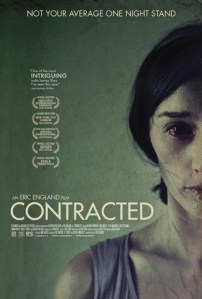
contractedI’ll start with CONTRACTED, because it’s the weaker movie of the two, although not for lack of talent by the main actress, Najarra Townsend. With her delicate brunette features and prominent cheekbones, she reminds me a lot of Rooney Mara, but she’s less introspective and more emotionally available to the audience (no dig against Mara, who I actually love in movies, just different acting style).

Townsend is easily the best part of an otherwise meh cast, and she makes the best of what seems like a somewhat amateur film. She and the gross-out effects make CONTRACTED worth a watch if you get the opportunity. Neflix pulled the film from its line-up, and I miss it already.

If AFFLICTED was a found-footage, up-close-and-personal look at developing vampirism, CONTRACTED is a standard film with an up-close-and-personal look at being infected by a zombie virus – in this case, a necrotic STD. The sequel made an attempt to explain the context of the virus, but the more horror is explained, sometimes the less you care. All that really matters is that a seriously unethical coroner appeared to have had sex with a dead person, then roofied Townsend’s already drunk character to have sex with her, and through that, she contracted the virus. Then everything already fraying in her life begins to completely fall apart in disgusting, spectacular fashion.

CONTRACTED went through a bit of controversy with the Netflix description of the night Samantha contracted the virus as a “one-night stand,” when the fact she was staggering drunk and then given a date-rape drug makes it pretty clear she’s raped. I mean, just look at the tagline on the poster image – implies the description was deliberate on the part of the studio, not a Neflix writer’s error. It doesn’t matter one bit that she gained a little consciousness in the middle of the act and seems to derive some pleasure from the sex, even as she’s telling him they should stop – although it seems like everyone seems to think that makes it okay, and her fault?

The sequel brings up the fact it was rape almost as an apology for the fact no one in the first movie seemed to realize that it was, including Sam, who never framed it as assault even when her lesbian lover accused her of having sex with a man. It’s tone-deaf, for sure, but a hell of a representation of why rape culture still needs to be discussed. (And CONTRACTED wasn’t the only one that seemed to miss the tonal mark with sexual assault.) It would have been one thing if it was clear either from the directorial perspective or someone’s perspective in the movie that what happened was rape, while everyone else didn’t get it, but I never got any impression that anyone was aware it was rape and not a one-night stand mistake.

Let’s move forward from that, though, to the post-contracted phase, which is when the movie and Townsend really start to shine, even though it’s kind of also where what little logic the movie has dissolves into so much goo.

The movie does amazing with the slow burn of the gross-out. It evolves little by little, although the movie takes place in less than three days. The early symptoms are relatively minor, but troubling enough to go to a clinic to test for an STD. She won’t get results back for a while, which is no help to her whatsoever. She’s given some cream for her genital rash and told the massive gout of blood out of her vagina is her period, even though it looks more like a miscarriage. At this point, I can see her wanting to hold her fragile life together and insist nothing’s wrong. I understand denial.

But when she vomits blood, I think that’s about time to go to the hospital, don’t you? She tries, but then somehow her boss ropes her into taking a shift, and instead of saying “No, dude, I’m vomiting blood,” she agrees and shows up looking thoroughly sick, with something that looks at least like raging pink eye, with another eye that’s jaundiced. And somehow, upon looking at her, her boss thinks, “That’s the kind of person I want serving people food.” He really only has himself to blame with that one.

And I know that when my daughter starts looking like an extra in a contagion film, my first thought is “Guess she’s gone back to drugs.” Sam’s bleeding, pussing, and rotting all over the place, and her mother brings a psychiatrist home to talk to her. Townsend’s so ugly-beautiful at this point, but everyone’s still completely clueless, and there’s a point at which it becomes ridiculous.

It’s hard to describe how perfect the gross-out effects are in this movie, though, how carefully spaced out they are, because the rest of the shit going on isn’t doing much to help – kind of like her friends and her indifferent lover, who’s clearly been looking to get off the train for a while, yet latches on to Sam having sex with a man as the final straw. Her body falling apart and her life in ruins, Sam officially jumps onto the crazy-train.

The best montage happens at this point – a pre-zombie girl dolling herself up for comfort sex that sounds like an extremely bad idea and may or may not be a symptom. And much blood and yuck was had.

It’s a silly and disgustingly beautiful movie, worth it for the effects and Townsend alone if you can stomach a wince-worthy script and uneven acting from the rest.

starry eyesWhich brings us to STARRY EYES. At its core, a completely different story – lovely but insecure young woman struggles to make it as an actress in LA, longing for her big break…oh, I’m sure you’ve heard this one before.
The movie opens on her pinching and prodding at her stomach, checking her butt, agonizing over how thin her hair has become. She works at a breastaurant to make ends meet, but she considers it beneath her. She has a supportive friend in her roommate (Amanda Fuller, one of my favorites), but her roommate has other starving artist friends who Sarah clearly thinks are insufferable – especially Erin, who appears to enjoy a touch more success and suffer less neurosis than Sarah, but who’s passive-aggressive in her superiority and played by the wonderful Fabianne Therese. Already, even though STARRY EYES feels like just as much of an indie film, the cast surpasses that of CONTRACTED. There are some undeveloped characters, but no bad actors.

And because there are no bad actors, Alex Essoe doesn’t have to carry the movie on her own shoulders the whole time. But she could. She brings layers to Sarah that most middle-of-the-road horror movies don’t even think about, and it shows. Every time I watch this movie, I read something a little different from her.

It would have been too easy to just make us hate Sarah or just make us love her, but Essoe does a really good job of making us empathize, even when we think she’s being as much of a bitch as Erin under the facade of the nice girl. She has a drive, a yearning for success and fame, and on that level we understand her – but there’s an ugliness underneath it, a desperation, an emptiness, that seems to be kept from the surface by the thinnest of paper. Ambition can be an amazing impetus, but there’s a fine line between good ambition and ambition gone bad. When you don’t have a solid acceptance of who you are as a foundation, ambition that doesn’t reach constant fruition risks turning back on its host, punishing internally as well as externally.

Ultimately, just like Astraeus Pictures’ film SILVER SCREAM, for which Sarah auditions, is supposed to be about the dark side of the ambition for fame, STARRY EYES brings that ugly underbelly up for everyone to see, and it does so with a great deal of self-awareness. It’s not quite meta-horror, because it’s a horror movie about movies rather than a horror movie about horror movies, but it flirts with that subgenre here and there.

We get a glimpse behind Sarah’s facade at the opening of the movie, but the magic really happens at the first audition for SILVER SCREAM, where the bland, creepy casting directors make their move to find something special in one of the girls trying out for their movies in the hopes of that big break. Sarah does a decent but indistinguishable audition. When the casting directors don’t seem all that interested, she reacts in a disproportionately frustrated way, with all of her anger directed at herself, throwing what amounts to a self-hating tantrum in the girls’ bathroom.

It’s a cumulative frustration, I know, but it’s still just one audition, and she puts so much pressure on herself to achieve, then blames herself entirely for being inadequate. She’s a miserable person, with that ugliness under her surface that’s more self-hating than she knows. Everything she hates about her roommate’s friends are things she’s afraid of in herself, a hallmark of narcissism – mediocre, talentless, invisible, poor, and she doesn’t even see how they’re so much happier than her because it’s more about the art for them than the fame. She’s afraid she’s just another one, and she’s desperate for some kind of external validation that she’s got something to offer, that she’s the talented one, that she’s the star. Whenever she doesn’t get that validation, she feels she has to punish herself. (It’s so common in perfectionism to motivate by punishment, but it doesn’t actually work.)

And here’s where it really connects with me, even though I’m not sure whether it’s the same thing. The reason why Sarah’s hair is so thin is because when she’s upset with herself, she pulls it and whole chunks get pulled out and drape between her fingers. I have trichotillomania myself, but I’m not certain whether what Sarah’s doing is supposed to be trich, or whether it’s self-harm punishment. There’s a certain drama to seeing full chunks of hair in a woman’s hand, but most trichsters pull one or a few hairs at a time. The bald spots we get add up over time. Maybe it’s supposed to be a little bit of both? Like, maybe they read about pulling out hair as a symptom of anxiety and depression and thought it meant chunks rather than one by one? Maybe they just wanted hers to be so extreme in comparison with the fastidiousness of most trichsters. Sometimes I watch depictions of hair-pulling disorders in the media (CSI:NY, Criminal Minds, and The Blacklist had other notable depictions), I wonder if that’s really how the world sees people like me, if that’s what I look like to other people when I’m pulling. It’s weird.

Anyway, right after Sarah’s through throwing her tantrum, she leaves the bathroom stall and walks straight into one of the casting directors, the incredibly disturbing Maria Olsen, who tells Sarah she finally has their interest. Thus begins a short series of auditions that go from red flags to fire alarms, designed to weed out only the most desperate and hungry of the bunch. It’s not exactly talent they’re looking for, which is good, because talent is in abundant supply, and talent isn’t even what Sarah wants – she wants acclaim for her talent, which is what Astraeus Pictures wants to give her…if she gives a little of herself in return.

Like CONTRACTED, there’s a tonal problem in the way the movie addresses the most controversial part of the movie, which I saw in a completely new light after the Weinstein scandal. This isn’t the first time the sleazy, boys’-club mentality of the Hollywood movers and shakers has been depicted in a horror movie – Scream 3 brought it up first. It’s no surprise that men in power use that power to get what they want, and I don’t doubt it’s still happening today, even with Weinstein disgraced. Women talk about it years later, if ever, which means what’s happening now won’t even come up until long after the fact. There’s still a few hurdles women have to go through to get somewhere, and the men making the rules and calling the shots are more than willing to take advantage of women’s desperation, to pluck the fruits of women’s ambition in a way that women (mostly) can’t achieve in the same positions.

So while characters in the film are stunned and derisive when they discover Sarah blew a producer for a “break-out” role in a horror film from a struggling production studio, their condemnation is almost completely on Sarah, and the audience is clearly supposed to agree. Extorting sexual favors for roles simply isn’t done anymore, and any self-respecting woman won’t hold for that, right? Well, reality is a tad more complicated. Sure, Sarah could have just walked away, and yes, she has a massively inflated, narcissistic ego to make up for her crippling insecurities, but the entertainment business is often one in which women do have to walk away if they don’t play ball, and that’s not right, either. Because male ambition is expected and encouraged, but female ambition is unseemly and seedy and suspect, and women need to do more to be seen as equally competent. It’s a troubling, tangled issue, this implicit condemnation more for Sarah than for the shady relic producer.

Astraeus Pictures are more than just shady, bringing on a bit of the ROSEMARY’S BABY vibe, and with the sacrifice placed upon the woman yet again. Here it is, ladies and gentlemen, the price for fame. You just have to die slowly and horribly and destroy everything around you. Sarah’s desire for fame and fortune is placed in the context of many early film starlets of the black-and-white era, for good reason. Once you learn some of their stories, you find that’s not much of an exaggeration. And if the SILVER SCREAM is a condemnation of naked ambition, I’m not sure whether STARRY EYES ever quite reaches a critique of the exploitation of that naked ambition so much as adds its voice into condemning the ambition itself.

This is point where STARRY EYES most closely parallels CONTRACTED, making use of Essoe’s thin frame and willingness to put maggots in her mouth (can’t fault a girl for her commitment to the role). Sarah gradually sheds her masks to expose the ugliness within, all inhibitions released, and her true feelings towards her roommate (with a tinge of envy and sexual attraction, am I reading that right?) and her roommates’ friends coming out of the woodwork. The process is faster than in CONTRACTED because it takes up less of the film, but it still follows the ‘pretty girl gone dead’ arc that’s truly fascinating to watch, culminating in a much less logic-twisted, blood-soaked ending.

It’s a more complete, complex, thoughtful film than CONTRACTED, but both are definitely worth the watch for fans of nitty-gritty, intimate body horror.

REVIEW: The Awakening

25 Saturday Aug 2018

Posted by amandamblake in Movie Reviews

≈ Leave a comment

Tags

depression, ghosts, grief, horror, mental illness, movie, movie review, rebecca hall, the awakening

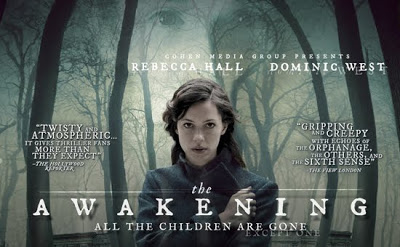
The Awakening

I think ghost stories are particularly difficult to make scary. They’re generally filed under the umbrella of horror monsters, but they’re more often tragic than frightening. That’s why there are so many ghost horror movies that depend on the jump scare—because that’s sometimes the only kinds of scares they offer. Let’s face it – the more you get to know them, the more lost spirits seem sad rather than scary (SIXTH SENSE kind of covers this phenomenon, and I’d consider SIXTH SENSE one of the better ghost horror movies). I think this is the reason a lot of movie hauntings have transitioned from the human spirits to the demonic. Ghost stories are extremely difficult to do well, especially when trying to find the right balance of tragedy and horror.

THE AWAKENING is one of my favorite ghost stories, but it is, without question, a better tragedy than it is a horror movie. I would say the closest comparison to the movie in tone, palette, and time period is THE OTHERS, which is also one of the better ghost horror movies. However, while THE AWAKENING has a few jump scares, it’s really shot as a drama rather than a horror movie most of the way through, which is good, because aside from some good tension here and there, it functions much better as a supernatural period drama.

I love the opening to THE AWAKENING. It begins with a quote from the main character’s book challenging the spiritualism movement prevalent at the beginning of the 20th by placing it in historical context. Between the Spanish flu and World War I, so many had lost people close to them under terrible circumstances. In the midst of survivor’s guilt, lack of closure, and an excess of grief. Florence Cathcart rightly points out, “This is a time for ghosts.”

The opening transitions into a classic seance, with the supernatural element rising higher and higher…only for Florence to interrupt the proceedings by exposing the spiritualist charlatans for what they are. Instead of being outraged at being taken advantage of, a woman who lost her young daughter – presumably to influenza – slaps Florence and asks whether she has any children. “No, of course you haven’t,” she replies with disdain, because a woman with children would know why a false dream was better than nothing. She questions whether Florence’s grief for the young soldier whose photograph she brought to the seance was even real. But as the mother leaves, we see Florence—played by the wonderful Rebecca Hall with arch strength and vulnerability—deflate. Her commanding, energetic presence dissipates. She appears weighed down, barely able to take another step.

In her own words, “This is a time for ghosts.” And it’s clear within the first fifteen minutes that, though Florence devotes herself to disproving hauntings and exposing frauds, she’s desperately seeking ghosts of her own. It gives her no pleasure at all to debunk the supernatural. Quite the contrary.

This entire movie offers some of the best depictions of depression and grief from a number of the characters that I think I’ve ever seen in a movie. The way it weighs you down and you sometimes don’t even want to move. The way it makes people lash out. The way you have to put on a mask, the way you lie to others and yourself, the way it takes over your life and cycles through your thoughts, the guilt, hopelessness, and self-destruction it can cause.

From the wonderful opening, AWAKENING moves into the main plot, with Robert Mallory—played by Dominic West as an attractive but caustic ex-soldier—an instructor from a boy’s boarding school, visiting Cathcart and requesting her help to put to rest rumors of a ghost boy haunting the school, after the death of one of the students. Usually the man would be the skeptic and the woman the believer, but like Mulder and Scully, AWAKENING switches that expectation on its head. Mallory believes in ghosts, but he’s also a firm realist, and he only wants the truth and to keep the kids safe, and the prim but earnest school matron, Maud, is a devotee of Cathcart’s work and recommended her.

At first, Cathcart is reluctant to engage in another investigation, weary as she is with her depression and needing a break, but Mallory throws her own words from her book back into her face, about how she was a fearful child and cannot abide children being made to live in fear – another point that resonates through the movie.

The boys’ school to which Mallory brings Florence is appropriately gothic, a looming, gray structure in the middle of nowhere, gloomy and forbidding, with energetic but somewhat melancholy students and a severe administration. With her, Florence brings the various accoutrements of her trade—a delightful look into the early twentieth century versions of our modern ghost-hunting gizmos, with all the scientific rigor of pre-WWII CSI. The dark manor at night provides some decent spookiness, but it’s pretty clear with the first tripped bell wire and footprints on the floor that the ghost boy traversing through the halls at that late hour is not so dead, and the tension dissipates…until something’s there that shouldn’t be.

And thus begins the slow unraveling of Ms. Cathcart. The most held-together characters of the movie lose their masks, exposing not ghosts but shells, broken survivors of any number of tragedies who must learn how to live with the ghosts of the people who passed on without them, and beyond the fear of mortality so keenly felt at a time that wrought the need for ghosts.

To be honest, the supernatural elements are sometimes the worst parts of the movie – the swirly face ghost is actually the worst effect, which is a shame, because that’s one of the few things you’re supposed to be afraid of.

The human elements – shattering perceptions and confronting fears – are by far the most interesting parts. I feel like I see something new every time I watch it. It’s a beautiful film and a beautiful, tragic story, and I do encourage you to give it a try on that merit rather than the horror.

Review: TEETH

07 Tuesday Aug 2018

Posted by amandamblake in Movie Reviews

≈ 1 Comment

Tags

castration, female revenge fantasy, high school is hell, horror, movie, self-discovery, sexual assault, teeth

Teeth_poster[Spoilers threaded throughout the review]
Based on my last post, you may wonder whether horror is the genre for me if sexual assault wears at my soul. But romance makes me sad, I find most comedy awful, and misogyny is everywhere. I like horror because sometimes women have or get the power.

In a film-making sense, I wouldn’t say that TEETH is great. It’s clearly low-budget, but more than that, something about it feels amateur, even naive, which is occasionally charming? I pose that as a question because the sometimes tentative/sometimes deliberate direction and the indie not-acting done by a lot of the actors in the movie didn’t bother me, but it was something I noticed, and I feel I shouldn’t notice things until the second viewing. But the naivete could also mirror our protagonist, Dawn, as she discovers herself. I’m a sucker for female self-discovery films like TEETH and RAW. RAW is better, but TEETH has its own qualities.

I can’t speak to how it is for guys, but women’s self-discovery is intrinsically difficult, because unlike cis guys, our junk is well between our legs and inside rather than convenient for viewing up front and center. Despite being raised in the far end of the Bible Belt, both my schools and my church made every effort to keep us informed. Ironically, our fifth grade puberty course at church was more comprehensive, but health classes going forward were more than adequate when it came to anatomy, for the nineties–which means there was and probably still is a dearth of information about variations in anatomy and queer genders and sexualities. Had to wait until college for that, not that I was really paying attention to variety until then.

But I know there are schools, churches, and homes where anatomy is undiscussed, as though if they don’t talk about it, nothing will happen (which has been true precisely never in the history of time). I was armed with all kinds of fascinating information–and I’m still fascinated–yet everything happening to me was so difficult to talk about, and it was all happening in places I couldn’t see and it all felt so much bigger and scarier than me. I used a mirror to look things over, but it’s not the same. Things you see in the mirror don’t feel connected to you–it’s a secondhand image.

So suffice it to say, I really identified with the wonderful, scary act of female self-discovery in TEETH, in a society that seems to prefer leaving woman mysterious (seriously, we didn’t know the clitoris went beyond the external glans and hood until 1999, people, and I will never let our scientists off the hook for that). Granted, I don’t have teeth in my vagina. At least, I don’t think I do.

Jess Weixler, who plays Dawn, is expected to carry the film, and with an otherwise uneven cast, her earnestness and raw skill elevates the rest of the movie. She’s endearing, engaging, and even when she’s the vice president of the purity doctrine, you still like her. She’s innocent, and you believe it, even though real innocence feels hard to come by.

But innocence arises from ignorance, and at her age, it’s really only a matter of time, even with the big censorship sticker on the cis female anatomy page in their school’s health book–and no, there’s no accompanying sticker for the penis. It’s just the vagina that’s icky and obscene (same principle that makes cock, dick, or prick less offensive for the average person than cunt, pussy, quim, or twat, not that there’s any real good name for genitals, for some reason). I’m not sure whether there are actual health classes that censor only one gender this way, but I hesitate to say it’s unbelievable.

You’ve probably heard of the premise of TEETH before. Teenager espouses purity culture (for those unfamiliar, it’s a primarily American Christian phenomenon that emphasizes saving sex until marriage, usually foregoing all forms of sexual activity, sometimes even going as far as forbidding kissing or any kind of touching at all). Purity teenager meets cute guy. They try to maintain the purity boundaries, though it’s clear she’s tempted and feels guilty because of it. However, cute boy pushes past those boundaries and forces himself on her–with the (intentionally) hysterically awful line “I haven’t jerked off since Easter!”

Well, turns out that power plant we saw from Dawn’s childhood did more than give her mom cancer. In that sense, TEETH could be considered a comic book origin story–villain or hero, take your pick. Dawn has vagina dentata, the myth (sadly) that women have teeth in their vagina and that a woman must be pleased in order to survive PIV sex with her. As a myth, nothing shows the fear of the mysteriousness of women’s parts quite like wondering whether her vagina’s going to bite your dick off. Why men aren’t more afraid we’re going to do that with our actual mouths, I don’t know, and given the prevalence of sexual assault even in places with variations of the myth, it couldn’t have been that believed.

But Dawn’s got it. Good for Dawn. And so begins the also hilarious castration motif. Seriously, though, penises are always funny-looking. Seeing them bitten off just emphasizes their ridiculousness.

Of course, it’s not funny to Dawn, who is traumatized twice in one afternoon. She’s blaming herself for the assault. She’s disenchanted with a purity script that now sees her as impure forever (previously chewed gum and dirty sticky tape analogies burn). She’s disenchanted with her fantasies of a pure wedding that culminates in sanctioned marital sex with a perfect gentleman from the same community. All her life, she’s defined herself against her stepbrother, who got bit as a juvenile offender fingering her in a kiddie pool and grew up into a ‘hardcore’ delinquent who now only does anal with his girlfriend while obsessing over Dawn, though unsure about his motives for either–but frankly, he’s not much of a thinker.

Dawn was the good girl. Dawn was never the problem child. Dawn was Little Miss Sunshine, Princess of Purity, and now she can’t see herself like that anymore. She tears down the childish purity propaganda she taped all over her bedroom walls–as a counterpoint to the porn plastered over her stepbrother’s room.

Thus begins her period of self-discovery, even though she’s afraid of herself, of being judged by her purity community, of being caught for what she did. She patiently soaks the sticker off the health text to try to understand herself and finally meets a vulva for the first time. She goes to a shady AF gynecologist, who finally gives her the name that’s been the stuff of jokes and legends: vagina dentata.

Traumatized once more–sex and puberty is honestly terrifying–she reaches out to someone who she thinks is a friend, and the cycle of men taking advantage and getting poetic justice continues, but she’s also gradually adjusting to her sexuality and–more important–the power she has because of it.

Seriously, though, there’s not a single castration you’ll regret. And in the midst of the horror, TEETH is at its heart a black comedy about female sexuality, so it’s okay to be horrified, and it’s okay to laugh. Even the poster is fantastic, evoking the NIGHTMARE ON ELM STREET bath scene and JAWS in equal measure, because it’s a supernatural horror movie and a creature feature at the same. One thing’s for sure–you will be entertained by this indie gem, which has already reached cult status among horror fans.

REVIEW: Gothika

14 Saturday Apr 2018

Posted by amandamblake in Movie Reviews

≈ Leave a comment

Tags

crazy, gaslighting, gothika, horror, hysteria, insanity, movie review, psych ward

GothikaThis is one of those movies where I can’t figure out if it’s deceptively good or just a personal pleasure, regular as comfort food.

It pushes one of my major buttons by being set in a psychiatric facility, which forgives a multitude of sins. When you’re crazy, I suspect you either love or hate psych ward suspense. I’m one of the ones who loves ’em. I process a lot of my shit through fiction, and psych ward horror brings up a lot of issues that I can healthily address through it, even when it’s sensationalized and mentally ill people othered for effect. So yeah, it’s problematic, but it still helps me deal with my problems. You just take some things with a grain of salt or a spoonful of sugar.

As horror movies go, this one suffers most in its script, with jarring lines all over the place. Here’s one of the juicier tidbits:

MIRANDA: I’m not deluded, Pete. I’m possessed.

PETE: I don’t believe in ghosts.

MIRANDA: Neither do I. But they believe in me.

Someone just thought they were so clever coming up with some of these lines and wouldn’t give them up for anything. I’m tempted to say they paid Halle Berry so much that they couldn’t afford a good script, but it’s more likely the script was destroyed in production, so I won’t unilaterally blame the writer, who has very little control over what happens when the script is out of their hands.

But a solid cast makes the most of cheap lines. You see Robert Downey, Jr., pre-redemption, which is a treat. With Penelope Cruz, Charles Dutton, and John Carroll Lynch rounding out the cast, it’s hard to go wrong. The only gross miscast would be Bernard Hill, who brings every ounce of gravitas he can to a fundamentally silly film. They really should have stopped with Dutton and Lynch for legitimacy.

And can we talk about the title for a second? A title that has absolutely no connection to the story, but someone thought it might have a Hot Topic baby goth kind of appeal? Sure, the story is pure modern Gothic—a looming psychiatric prison, female madness, a cool, dark palette, gaslighting. But where the hell did the K come from? Considering the motif of NOT ALONE, they should have just gone with that instead.

Okay, now that I’m writing this review, I’m pretty sure the movie is just a guilty pleasure.

But there are things about GOTHIKA that do work and let you see the good the movie could have been. The palette alternates between a gentler gray blue and a sickening green (a common palette for horror in the early 2000s, but it really worked here). Like the contrast between clean institutional rooms and rundown Gothic architecture, it visually disorients in a setting where you think they’d be more interested in soothing its inhabitants (except the place is for the criminally insane, so maybe they kinda want to punish them, too).

The role gives Halle Berry somewhere to use her earnest emotional energy in a place where it fits. Most of the time, I want her to dial it back a click or two, but in a story essentially about the perception of female hysteria, her brand of emotion feeds that question of sanity, and she does small, fierce, and determined very well. The trouble is, when she’s playing the doctor, she’s supposed to be the best, yet her more clinical lines come off as those of a novice (script, again), and she doesn’t seem to even take herself seriously as a doctor. Her demeanor lacks assertiveness or authority. If I thought that was a deliberate choice to highlight female mollification of male ego or a case of Imposter Syndrome, I’d be more forgiving. But because I suspect she’s supposed to seem competent, I can’t be quite so forgiving.

However, once the instigating incident occurs and Berry’s character Miranda is incarcerated among her patients, including Cruz, things become much more interesting, if not exactly consistent. Even allowing for flawed communication between the living and the dead, the ghost makes very little sense, and the story deserved better. However, the motif of NOT ALONE throughout the movie appeals to me, because the meaning changes each time, yet each meaning holds its own weight—and might sound terribly familiar in the midst of the #MeToo movement.

[HERE THERE BE SPOILERS]

When it comes to the suspense payout, though, the farmhouse reveal lost me a bit when it comes to timeline logic. When Dutton’s character is addressing the camera, is he addressing his wife directly, with the anticipation of bringing her down there soon (or again)? Is the woman in the video the one chained down there or Miranda herself? There’s a suggestion that she might have been a victim herself and not known it, connecting her with Cruz’s character and continuing with the theme of repression for the purpose of survival that was introduced through the conservation Dutton’s character had with his wife in the beginning. Was Dutton’s character addressing himself as a continuation of that conversation? Does he say “I love you” to himself, his wife, his victim, or his partner? The malleability of NOT ALONE may point to all of these options as being possible and open to interpretation, but I might be too generous, and in order for all of them to work, there needs to be solid evidence for all like the NOT ALONE motif, but instead, there’s not solid evidence for any.

When I first saw the movie, I wasn’t as aware of Lynch’s reputation, nor had I learned to recognize certain thriller patterns, so I didn’t see the twist coming, but as endings go, it suffered the horror curse of being underwhelming, with amateurish FX, not to mention more jarringly bad lines that did not work. What kind of doped-up villain sees a ghost and goes, “No…this isn’t rational”? Seriously.

The epilogue was similarly ‘why?’ Although it was good to have a reunion between Miranda and Cruz’s character Chloe, since the movie opened with them, I think there could have been a much better way of handling it—perhaps back at the facility, something to reinforce Chloe’s survival to bookend the repression-as-survival concept. Really, they didn’t focus enough on that, and I wish they had. They only really discussed it in terms of doctors using repression as a reason to dismiss women’s stories.

So the ending wasn’t quite satisfying, but the story’s main strength comes in the middle, in the space between the sane and insane, when Miranda grapples with that question herself and the people who knew her as the doctor suddenly start treating her like a child. It’s as Chloe explains, “You are not a doctor in here. And even if you the tell the truth…no one will listen. You know why? Because you’re crazy. And the more you try to prove them wrong, the crazier you’ll appear. You are invisible now. Can you feel it?”

The treatment, infantilization, and utter dismissal of the mentally ill as though we have nothing to offer (in the parts of our brain that are unaffected, but even in the places where our perception is different) is worth shining a light on—as though skewed perception in one area steals credibility from everything else as well. In the case of women, it’s long been used as a way to interpret the slightest bit of emotion as hysteria, rebellion as insanity, and all that as a reason to lock a woman away for her own good. People totally believed that, and sometimes still do. Because once you’re labelled insane, all of a sudden you have no voice. No one listens to what you have to say, only to what a doctor says you mean. (This is a big reason why I sometimes have to listen to Emilie Autumn.)

Some of the best scenes are between Miranda and Chloe, as well as Miranda with Robert Downey, Jr.’s character, Pete. Easily the best scene in the movie is after Miranda wakes up in the institution, when she’s sure she’s sane and doesn’t know what’s happened, but everyone’s treating her as dangerously psychotic, and she’s terrified and vulnerable. When she fights Pete’s hold, the sexual tension established between them becomes so twisted, which it’s clearly supposed to. Then Berry and Downey engage in a clinical back and forth that’s just beautiful in its quiet simplicity. The entire bit has such nuanced performances from each actor, it’s a real gem in an otherwise middling movie.

All in all, it’s a film that could have been better, but I still love it in all its hot mess glory, and it has enough rough gems to mine that it’s worth a watch if you like gaslight horror or are interested in a shameless popcorn movie on a rainy night.

Seriously, though, at least three-quarters of the movie takes place during a downpour, so waiting for a rainy night really helps.

REVIEW: Would You Rather

26 Monday Mar 2018

Posted by amandamblake in Movie Reviews

≈ Leave a comment

Tags

body horror, class warfare, dark humanity, horror, locked room, movie, movie review, social commentary, torture, wealth disparity, would you rather

Would-You-Rather-354x525I’ve been wanting to write a review about this movie for a while, but I just didn’t have anything substantive to say about it, other than that it pushed a lot of good buttons. I’m a fan of locked-room horror, because it feels almost like a play. It evokes intimacy, then as things get more intense, claustrophobia. I also have a soft spot for adolescent games turned dark, which is why I liked TRUTH OR DIE and will probably love TRUTH OR DARE when it comes out next month.

The cast is also fantastic and varied, with Brittany Snow, horror alum Jeffrey Combs, Robin Lord Taylor, and Enver Gjokaj, plus a number of other familiar faces. Really, in dinner theater, there’s nothing better than bringing together an amazing cast, because even the small parts are given greater intensity.

(Side note: It also has a wonderful, subtle opening credit sequence that I love. Reminds me of the opening credits of MADHOUSE in terms of beauty and CABIN FEVER in terms of slow-burn subtlety—which was about the only thing in the original CABIN FEVER that was slow-burn subtle, by the way.)

On its surface, WOULD YOU RATHER is a simple sadistic tale in a post-SAW gorescape of bringing a group of flawed people into a space and making them torture each other. For WOULD YOU RATHER, though, a smaller budget makes the situations seem much more realistic in scope and execution and less of a spectacle. As gore goes, it’s minimal, playing off implication and imagination rather than showing the blood. Not that it goes easy on you.

The premise: Wealthy patron invites down-on-their-luck individuals for dinner for a chance to win a substantial amount of money. The exact amount is never specified, but it’s suggested that it will take care of all immediate debt and whatever else an individual needs to get back on their feet, and then some.

It doesn’t go well.

The reason I decided to finally write a review is that this small, scrappy little gem takes on a disturbingly relevant tone these days.

Haves versus have nots is an old conflict. Ever since we’ve had an economy, we’ve had wealth disparity and its resultant tension. But as wealth disparity grows and the poorer get blamed for it, that tension’s only going to get worse. As our present administrations continue to cut safety nets and entitlements, as health care costs soar, as student loans continue to burden the generations entering adulthood, as corporations continue to blame millennials for their own lack of wealth that makes the increasingly more expensive markers of adulthood out of reach, as affordable housing and decent food and other staples rise in price against stagnant wages…the tensions continue to escalate. Between the haves and have nots, of course, but also between each subsection of the have nots, because it’s an insidious strategy to pit the have nots against each other in the blame game so they don’t have enough energy to combat the haves. (See: THE HUNGER GAMES. Also: A BUG’S LIFE, which is unexpectedly political.)

And here we have a wealthy, white psychopath and his lazy, spoiled brat rapist son bringing debt-ridden people together to torture each other for their own entertainment…because they know they can. At the very beginning, we see the signs. In the doctor’s office where he courts Snow’s character to the dinner party, he’s eating either peanuts or sunflower seeds on the couch and discarding the shells on the cushion next to him. Not in a bowl, not in an ashtray, not in a tissue, not in a trashcan. He’s in a doctor’s office, discarding his trash on the furniture without any regard to the impact of his actions. We see where he’s put himself in the hierarchy.

The host laughs as he convinces a vegetarian to eat meat for ten thousand dollars. He laughs as he convinces a recovering alcoholic to drink a bottle of scotch for fifty thousand. In a world where one major illness can wipe out everything, where mental and chronic illness can make functioning to production standards impossible, where addicts are entirely blamed for their addictions when one moment of weakness shouldn’t lead to a lifetime of damnation just because of an exploited trick of brain chemistry, where being poor is so goddamn expensive while rich people get free things handed to them on the platter as though they’re lucky cats…blaming have nots for their own circumstances has become more unconscionable, yet the rhetoric seems to have only increased.

(In the interest of full disclosure, I’m a white millennial with the additional privilege of parental wealth. I’m still angry on behalf of friends who get shit on. And frankly, on behalf of total strangers, too. This doesn’t have to be personal and I don’t have to have stakes in the game for me to care.)

But here we have a self-made man who sees a table full of losers, who feels he’s completely entitled to do anything he wants, because he has the money and they want it and are willing to do anything for it. All they have to do is sacrifice everything. And even then, only the winner gets it. All of them will sacrifice everything, but the winner takes all. So you see, friends, if you just work harder… Never mind that luck plays a significant role in the game as well.

Suffice it to say, the movie feels far more allegorical than the first dozen times I saw it. Even the deaths and how each player relates to each other seems more significant. For instance, it doesn’t seem coincidental that the pretty blonde protagonist gets as far as she does.

Don’t get me wrong. She’s a driven young woman. And though she’s hardly the physically strongest person there, quite slight in stature in comparison with everyone but Sasha Grey’s character, the Lambrick Foundation chose her because she’s fighting for someone else, and that sometimes makes a bigger difference than fighting for yourself. Brittany Snow does a fantastic job leading the ensemble with her vulnerability, and it’s worth watching her reach the point where she changes from a scared, passive victim to someone determined to survive.

But it’s still a stunning lesson in privilege, presided over by a man with a Draco Malfoy-like son who thinks he’s superior because he was born into wealth by no effort of his own and, like his father, is bailed out of his own criminal activity, excused for it supposedly because of the trauma of his mother’s death. Yet somehow, he deserves his wealth more, and everyone else in that room deserves to sing for their supper until they die.

It’s a blistering indictment. It really is. When a dinner party turned slaughterhouse is a rich man’s solution for who deserves his charity (which, when it has strings, isn’t charity at all), when compassion doesn’t even enter the conversation, when dire straits are viewed as just deserts and help something you must earn at the cost of your life or someone else’s, something is seriously wrong. The one percent may not be putting people through such individualized, intimate torture, but it is actually a matter of life and death. People are dying. And on their potter’s field headstones, it might as well read: Should have bootstrapped harder.

In that light, easily the most chilling line: “You know, you agreed to be here. You’re basically asking my family for a handout. The least you could do, pig, is show a little fucking respect.”

Beyond the social horror, though, the low-budget torture goes back to the classics. Really, there’s no need for genius, Inquisition-level engineering. The standards are standards for a reason, and the impact isn’t lower because of the utter, beautiful, sadistic simplicity of it all. As the players submit to the deadly game in their own desperation and will to survive, you’ll be asked the same questions. “Would you rather?” stripped down is just “Under the right circumstances, what are you willing to do?” As countless unethical social experiments have shown, we’ll always be horrified by the answer.

← Older posts
Newer posts →

Enter your email address to follow this blog and receive notifications of new posts by email.

NOW AVAILABLE

WHERE IT ALL BEGINS

TINGLE YOUR SPINE

Website Built with WordPress.com.

  • Subscribe Subscribed
    • Amanda M. Blake
    • Join 146 other subscribers
    • Already have a WordPress.com account? Log in now.
    • Amanda M. Blake
    • Subscribe Subscribed
    • Sign up
    • Log in
    • Report this content
    • View site in Reader
    • Manage subscriptions
    • Collapse this bar
 

Loading Comments...